
 EN
EN
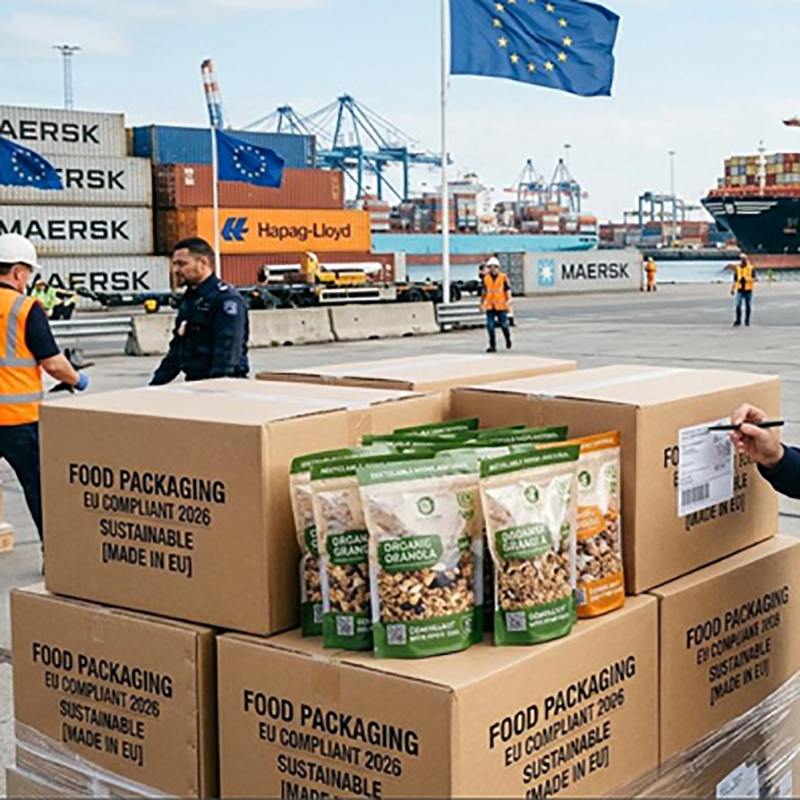
2026 is a critical year for food and beverage exporters,international trade managers, and brand compliance officers. The European Union is revamping its border controls,verification procedures, and taxation of packaging. But the lack of understanding of these changes can lead to fines,lost shipments,and even being barred from the world's biggest premium food market. This roadmap provides an overview of compliance in 2026 and how Cailyn will be your strategic partner in this journey.
The EU Plastic Tax Mechanism: How It Works and What It Costs
The EU’s own resource on plastic is popularly known as the EU “Plastic Tax”. It is not an actual tax on your firm. Rather,all member states contribute to the EU budget based on the weight of plastic packaging waste they produce on their territory that is not recycled. Currently it costs €0.80/kg, and the European Commission is proposing it will rise to €1.00/kg from 2028 and be subject to inflation indexing annually afterwards.
Increasingly, the cost is being passed down the supply chain to businesses. The price of non-reusable and non-recycled plastic packaging placed on the market in Spain is already €0.45 per kg. The plastic packaging tax,which is also €0.45 per kg,was postponed several times in Italy,but is still set for application. For an exporter shipping a container with 10,000 kg of plastic protective packaging and 1,000 kg of non-recyclable food pouches,the plastic tax liability can exceed €12,500 per shipment before national taxes are applied. This figure includes the EU own resource added on top of national taxes.
The monetary damage directly impacts your margins. These tax exposures can be avoided or reduced in some member states via the use of packaging that is made from at least 30% post-consumer recycled (PCR) material. Choosing the right material is a financial decision,not just an environmental one.
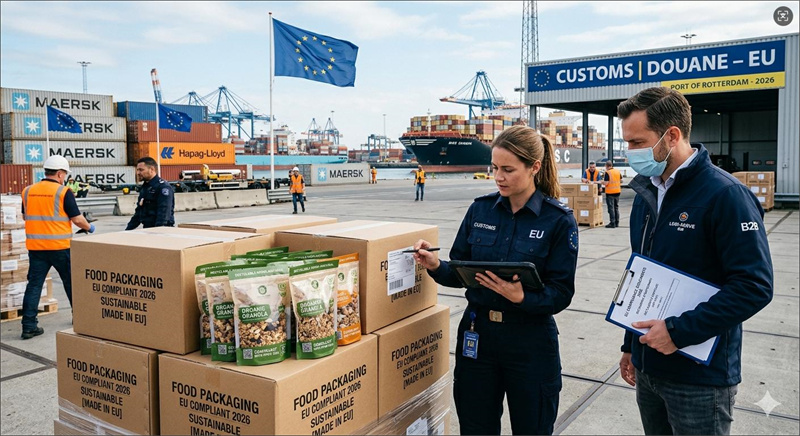
PPWR 2026: The Regulation That Changes Everything
The old packaging directive has been replaced by the Packaging and Packaging Waste Regulation (PPWR) which entered into force on 11 February 2025. It will take effect on 12 August 2026—so it is important that every food importer remember that date.
From that date, all food-contact packaging with per- and polyfluoroalkyl substances (PFAS) above specified concentration limits are no longer allowed on the EU market. PFAS (often referred to as forever chemicals) are used in the manufacture of greaseproof paper packaging and some flexible films.
Further, it must be ensured that all packaging is designed for recycling. The design-for-recycling principle comes into effect in 2026, and "recyclable at scale" requirements will be phased in starting from 2035. Unsortable and non-recyclable packaging will grow more expensive with taxes and have a greater chance of being denied access to the market.
PPWR also requires Extended Producer Responsibility (EPR). As an importer you have a legal obligation for the management of end-of-life for all packages you import into the EU. Registration with the producer responsibility scheme in each destination country is compulsory,and fees depend on packaging weight and recycling performance.
New Import Controls for Recycled Plastic Food Contact Materials
On 15 April 2026,the EU notified the WTO of a proposed regulation on recycled plastic food contact materials (recycled plastics). This proposal (due to be adopted on 30 September 2026) introduces four new declaration types:
Declaration P for partially pre-processed plastic input
Declaration C for finished recycled plastic product, for which the composition will not be further changed in the product’s next processing.
New data and information requirements will apply to Declarations A and B for recyclers and converters.
The draft prescribes specific documentation requirements for releasing imported products for free circulation,which is a crucial aspect. Some PET products,such as packaging articles,will require declarations of compliance based on specific CN (Combined Nomenclature) codes.
If you are an importer,it is crucial that the packaging supplier in China or Southeast Asia is able to present any supporting documentation at the border. Otherwise,your shipment can be held or destroyed by customs. A twelve months transitional period will be provided to allow for existing stock to be used up,but full documentation will be required by the start of 2027.
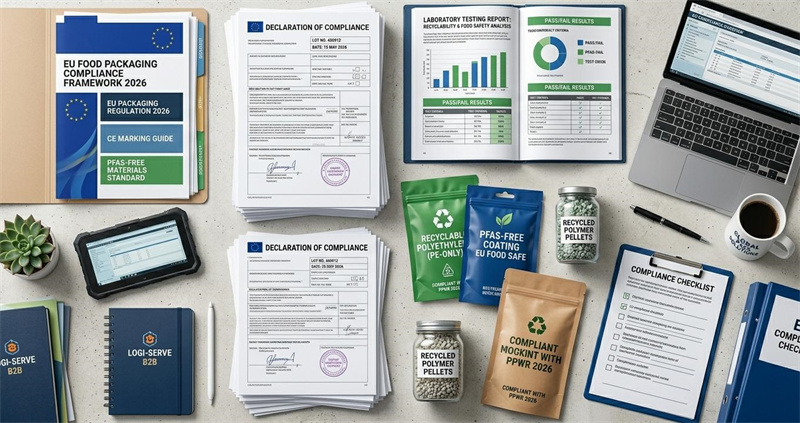
Declaration of Compliance: Your Border Pass
All food contact packaging shipments going into the EU should be accompanied by a Declaration of Compliance (DoC) as specified in Regulation (EC) 1935/2004. The following information is to be contained in this document in 2026:
Identify and describe all the layers in the packaging.
Compliance proof of heavy metals and other regulated substances in terms of migration limits.
Percentage of recycled content,as certified by GRS or other certification body.
The PPWR grade A to E,with grade C being the minimum acceptable as of 2030.
Declaration that food-contact materials are PFAS-free.
You won't be able to get the shipment customs cleared without a DoC from a certified supplier! In recent years,major retailers in Europe such as Aldi,Lidl and Tesco, have begun to independently audit suppliers,and will not accept any packaging without full compliance documentation.
Cailyn as Your Global Supply Chain Compliance Partner
Going through this regulatory labyrinth isn't a matter of a supplier – it's a matter of a partner who is on top of the rules and designs packaging around them. Cailyn's in-house factory and compliance team offer just this.
The PE/PE mono-material recyclable coffee bags and flexible pouches are designed to the standards of the PPWR,and are 100% mono-material (PE) with high barrier EVOH. We provide:
· Full Declaration of Compliance documentation for every shipment
· OTR/WVTR test reports per ASTM standards
· PFAS-free certification for food-contact materials
· Recycled content verification with traceable certification
· How2Recycle-compliant labeling for EU market requirements
We are ISO 9001 and BRCGS Food Safety certified,FDA approved,and certified to the European food-grade standard LFGB. From the PPWR application dates to the new import control proposals,we constantly follow developments within the EU,ensuring your packaging evolves with the law rather than lagging behind it.
Your 2026 Compliance Roadmap
If you are already exporting food and/or drinks to the EU market,do the following before 12 August 2026:
First,review current packaging to identify those that are prohibited due to PFAS content and those that are not recyclable. Second,request recycled content verification from packaging suppliers. Request new Declarations of Compliance that include recycled content verification. Thirdly,make sure that you have registered for EPR schemes in all EU countries in which you are selling. Fourthly,move to mono-material or certified recyclable packaging in all flexible packaging.
Cailyn is there to help you every step of the way.
Get a 2026 EU Packaging Compliance Audit for Your Current Packaging.
Table of Contents
- The EU Plastic Tax Mechanism: How It Works and What It Costs
- PPWR 2026: The Regulation That Changes Everything
- New Import Controls for Recycled Plastic Food Contact Materials
- Declaration P for partially pre-processed plastic input
- Declaration of Compliance: Your Border Pass
- Cailyn as Your Global Supply Chain Compliance Partner
- Your 2026 Compliance Roadmap