
 EN
EN
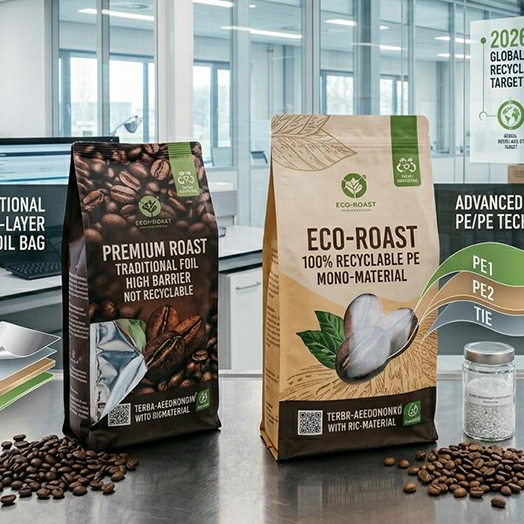
One topic that has long been discussed in the packaging industry is whether a recyclable coffee bag can deliver the same level of protection as traditional foil laminates. The answer is yes—but only for the proper mono-material structure. This guide outlines how today's PE/PE recyclable coffee packaging can provide oxygen and moisture barrier that approaches foil properties and be fully compatible with existing plastic recycling streams.
The Traditional Foil Advantage: Absolute Barrier at a Cost
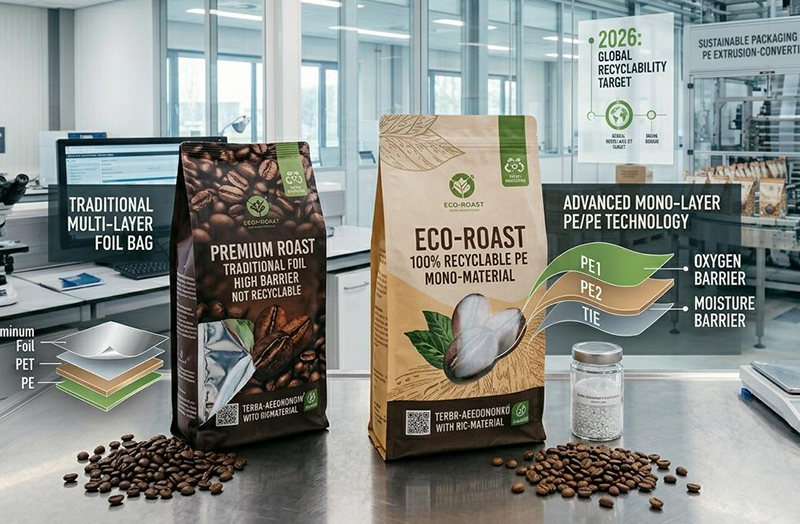
Traditional coffee packaging is based on multi-material laminates,which are usually PET (polyester) / aluminum foil / PE (polyethylene). The oxygen transmission rate (OTR) and water vapor transmission rate (WVTR) of the aluminum foil layer are less than 0.05 cc/m²/day and 0.1 g/m²/day respectively,which are essentially absolute barrier. The shelf life of coffee is 18-24 months. However,this structure cannot be recycled. Separation of the PET, aluminum and PE layers is not possible in the traditional recycling plants. The vast majority of coffee bags with foil are sent to landfills or incinerated. That's no longer acceptable for brands that have public commitments to sustainability.
The PE/PE Mono-Material Solution: Engineered for Recyclability
Mono-material packaging is packaging that is made from a single polymer family; in this case, polyethylene (PE) for all layers. A PE/PE recyclable coffee bag is composed of machine-direction oriented PE (MDO-PE) layers:an outer layer that provides stiffness and printability,a barrier layer of EVOH (ethylene vinyl alcohol) to protect against oxygen,and an innter sealant layer of PE that seals the bag. Given that all layers are polyethylene based,the whole structure fits in with the existing polyethylene recycling streams. No layer separation is required. The bag is usable at the end-of-life for new plastic products like trash liners, agricultural film or industrial packaging.
Barrier Performance: How Close Can PE/PE Get to Foil?
| Property | Traditional Foil Laminate | PE/PE Mono-Material |
| Recyclability | Not recyclable | Recyclable in PE streams |
| Structure | PET / Aluminum / PE | All PE-based |
| OTR | <0.05 cc/m²/day | 0.2–1.5 cc/m²/day |
| WVTR | <0.1 g/m²/day | 0.3–0.8 g/m²/day |
| Shelf Life | 18–24 months | 9–12 months |
| Sustainability | Low | High |
| Recycling Compatibility | Poor | Excellent |
| PPWR Compliance | Limited | Recyclable by design |
| Typical Use | Export / long shelf-life | Sustainable retail packaging |
The barrier performance of PE/PE mono-material is related to the thickness and EVOH content. The OTR of the standard EVOH-based recyclable coffee bags is 0.5–1.5 cc/m²/day and WVTR is 0.3–0.8 g/m²/day. High-performance EVOH with nano-fillers can achieve an OTR as low as 0.2 cc/m²/day. For comparison,foil achieves 0.05 cc/m²/day. In most instances,whole bean/ground coffee can be protected for 9 – 12 months by an OTR of 1.0 cc/m²/day,which is more than adequate to meet the needs of regional roasters and direct-to-consumer brands. If 18-month stability is required for national or export brands,Cailyn will provide a multi-layer PE/PE structure with high EVOH content and sufficient special tie layers to achieve an OTR below 0.3 cc/m²/day,which is close to foil.
Moisture Protection and Aroma Retention
The second threat to coffee is moisture. The WVTR is lower than 0.1 g/m²/day for foil. The 0.3–0.5 g/m²/day performance of PE/PE mono-material protects coffee from everything except the most severe tropical warehouse conditions (air humidity above 90% for more than 24 hours). If your brand sells products into humid regions such as Southeast Asia or Florida,Cailyn recommends using a desiccant pack or choosing the foil lined option for those specific SKUs. PE/PE mono-material performs better at retaining aroma than many people think. The PE sealant layer has low affinity for coffee’s volatile organic compounds (VOCs). PE/PE recyclable coffee packaging can preserve the original aroma compounds for 88-92% over 12 months,whereas foil can preserve the aroma compounds for 95-97% over 12 months. In a blind taste test,this difference is not noticeable to most consumers.
Practical Considerations for Recycling
A package can only be recyclable if it is in the recycling stream. Recyclable coffee bags need to be collected clean and dry and a local film recycler needs to accept PE mono-material flex films. According to Packaging and Packaging Waste Regulation (PPWR),in the EU,mono-material PE is classified as “recyclable by design” and offers reduced EPR (Extended Producer Responsibility) fees. PE films are accepted at drop-off sites in North America,such as grocery stores,through programs like How2Recycle. Cailyn offers How2Recycle labeling for all PE/PE recyclable coffee packaging,as well as brand sustainability report documentation.
Degassing Valves and Zippers on Mono-Material Structures
One argument is that degassing valves and zippers which are difficult to remove,make recycling impossible. Cailyn offers two solutions to this problem. First,we provide degassing valves for PE without the need to unplug the valve,ensuring that the entire package can be recycled in PE streams. Second,for zippers we use PE zipper track which can be recycled as mono material. The zipper must be cut off by the consumer before recycling – as is customary with all flexible packaging zippers. For brands focused on recyclability rather than convenience,we recommend heat sealed recyclable coffee bags without zippers and with tear notches for opening.
Cost Comparison: Mono-Material vs. Foil
Cost of recyclable packaging for coffee,which is 15–25% higher than the cost of equivalent foil structures,is driven by the price of MDO-PE resin and the high barrier EVOH resin. But for brands targeting eco-conscious shoppers,it's a value that they can recoup by charging more in retail price or building up brand equity. Moreover,with the scale up of PE/PE production,prices are decreasing. The premium mono-material price will be 10 to 15% cheaper than the standard foil price by 2026. Both structures are provided with Cailyn to allow a gradual transition to either foil or recyclable PE/PE for export SKUs and domestic/retail SKUs, respectively.
Applications Beyond Coffee
The same mono-material technology can be used for other dry goods. Cailyn produces recyclable PE/PE sustainable coffee packaging,as well as recyclable pouches for snacks,nuts,dried fruit,and pet treats. For each application we match the barrier level with the shelf life required without over-engineering (and over-paying) to provide unnecessary barrier performance.
Conclusion: Recyclable Is Ready for Mainstream Coffee
PE/PE mono-material recyclable coffee bags are now catching up with the traditional foil. However,for most coffee applications requiring a 9-12 month shelf life,the slightly lower barrier performance (OTR 0.2–1.5 cc/m²/day) is sufficient. When freshness is paramount and brands do not want to sacrifice sustainability,PE/PE is the obvious solution. How2Recycle label compliance and documented OTR/WVTR test reports as well as optional PE-based degassing valves are available for Cailyn's recyclable coffee packaging. Make your coffee bag a part of the circular economy with a free consultation and custom printing plan today.
Table of Contents
- The Traditional Foil Advantage: Absolute Barrier at a Cost
- The PE/PE Mono-Material Solution: Engineered for Recyclability
- Moisture Protection and Aroma Retention
- Practical Considerations for Recycling
- Degassing Valves and Zippers on Mono-Material Structures
- Cost Comparison: Mono-Material vs. Foil
- Applications Beyond Coffee
- Conclusion: Recyclable Is Ready for Mainstream Coffee