
 EN
EN
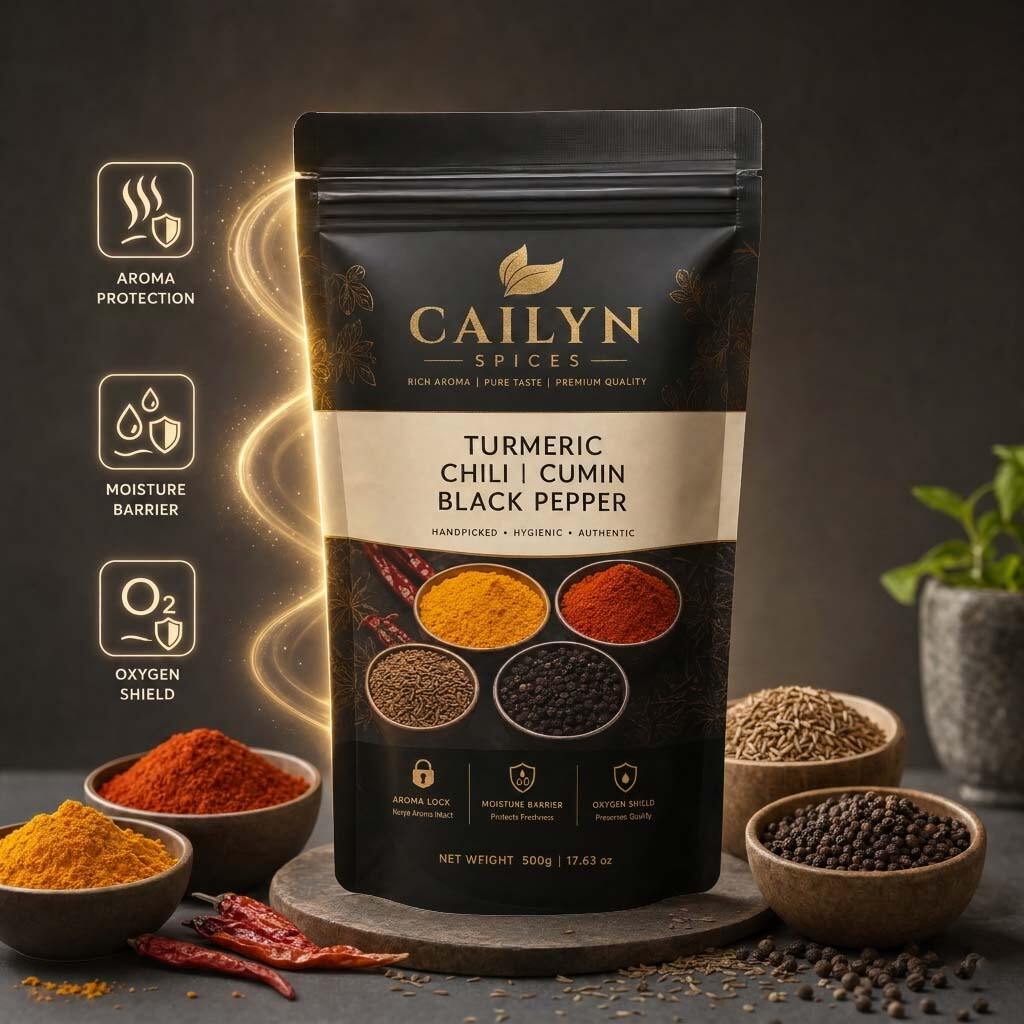
For spice wholesalers, owners of organic spice brands,and buyers of food ingredient packaging, packaging isn't just an envelope-it's a flavor preservation system. Three threats can render any spice or spice blend to unacceptable:moisture ingress (causing caking and mold),oxygen ingress (reducing color and causing rancidity of any oils present in the spice),and aroma migration (out of or into the package). High-barrier packaging pouches overcome these challenges. We advise you on best practices and tailor-made solutions for managing high-humidity powders like garlic and onion.
Understanding Aroma Migration and Delamination Risks
Aroma migration refers to the passage of volatile organic compounds (VOCs) responsible for the spice's characteristic odor and flavor,through the packaging material. Essential oils found in oregano,cumin,cinnamon etc. are small,typically 0.4 to 0.7 nanometers in size. They are very mobile and will easily dissolve in conventional polyethylene or polypropylene films,then emerge on the outside of the pouch. Over a period of weeks or months,the spice will no longer be potent and products next to it may absorb stray aromas. The result can ruin a pallet of mixed spices.
Delamination is another,related danger to any laminate structure. Oils can degrade the adhesive that binds one layer of film to another. Strong spices such as clove,cinnamon or chili extracts act like solvents and attack the bond within poor laminate structures causing it to separate. Delamination destroys the barrier and the packaging no longer looks professional and cannot be used. Cailyn constructs high barrier pouches using oil resistant adhesive to avoid problems like this,and even completely eliminates the adhesive by co-extruding the required barrier into the plastic layers for spices high in essential oil.
OTR and MVTR: The Critical Numbers for Spice Preservation
OTR (Oxygen Transmission Rate) and MVTR (Moisture Vapor Transmission Rate,also known as WVTR) are the two main indicators of a packaging’s quality and how it will perform in different environmental conditions. Oxygen breaks down spices’ color. For example,turmeric will go from bright yellow to beige in a month while paprika will turn brown. Moisture,on the other hand causes spices and blends to clump,and eventually mold, losing their free-flowing form.
Standard LDPE or PP pouch:OTR 100-200 cc/m²/day,MVTR 5-10 g/m²/day – bad for any spice and only useful for immediate consumption.
Metallized PET pouch:OTR 1-3 cc/m²/day,MVTR 0.5-1 g/m²/day – suitable for low-oil/low-moisture spices like black pepper and cumin seed.
High barrier pouch with EVOH:OTR 0.5-1 cc/m²/day,MVTR 0.3-0.7 g/m²/day – suitable for moderate oil spices,especially ground spices and mixes.
Aluminum foil lined pouch:OTR < 0.05 cc/m²/day,MVTR < 0.1 g/m²/day – must be used for highly oil spiced products (oregano,cinnamon,cloves) and all products that will be sold in the tropics or in high-humidity markets.
Cailyn can accommodate all these levels of barrier protection and we provide OTR and MVTR documentation.
Specialized Solutions for High-Humidity Powders: Garlic and Onion
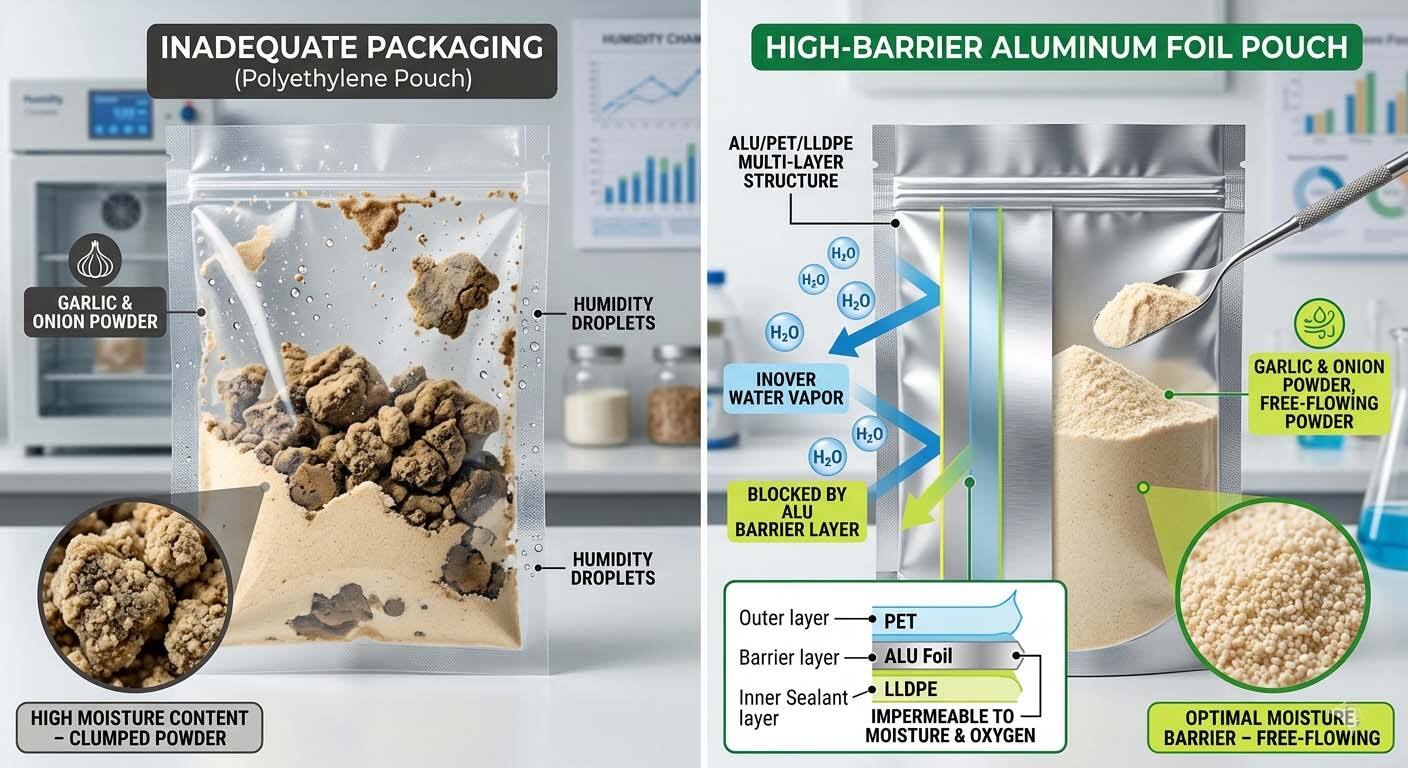
Garlic and onion powders,by definition,pull moisture out of the air. Once they surpass 6-8% moisture,they harden into unpourable blocks that could eventually mold. As for aroma, garlic and onion powders contain large numbers of sulfur based molecules which have enormous aroma potential,and could penetrate any conventional packaging material within weeks. This high barrier pouch features a 12-micron aluminum foil oxygen/aroma barrier,covered by 70 gauge nylon for puncture protection,and sealed with a 100-micron low-density polyethylene film. The seal area includes an anti-static additive to prevent spices from sticking to the seals. The performance is below 0.05cc/m²/day OTR and <0.1g/m²/day MVTR,which ensure the spice will remain free-flowing for well over 18 months. Alternatively,the pouch can include a desiccant in an inner compartment.
Resealability: Maintaining Barrier Performance After Opening
Resealable pouches are needed in many food service and bulk retail applications. However,the barrier levels of a normal zip-closure may fail after about 10 to 20 uses. The design of a standard press to close zipper can degrade quickly over this number of cycles. Cailyn has developed two new types of closure. The Fresh-lock zipper features crush-proof interlocking rails that provide the same level of barrier performance after 50+ cycles as they did at cycle one. Additionally,if premium brand identity is needed,we can produce a press to close zipper with a ridged track system that seals when pushed, providing tactile and audible feedback when closed. For bulk wholesale use or any application that doesn’t require a resealable closure,three-side seal bags will perform identically once the pouch has been opened.
Multi-Layer Structure: Engineering the Perfect Spice Pouch
Any spice packaging pouch requires 4 to 5 different layers for optimum protection. The outer film will be a substrate such as PET or OPP providing a scuff resistant and printable surface. Beneath the outer film is the barrier layer (aluminum foil,metallized PET,or EVOH) ,followed by a tie layer that bonds it to the inner seal layer. The inner seal layer is polyethelene or PP,which is heat sealed to ensure integrity. For organic brands,we offer full traceability for each material from resin supplier to finished pouch. We also provide a mono material structure in which EVOH film is extruded into polyethelene,delivering near foil performance while remaining 100% recyclable.
Applications Across Spice Categories
Different spice classes require varying levels of barrier. Whole spices such as peppercorns and coriander seed have no issue with oxidation but need protection against moisture;they can benefit from a metallized pouch with a degassing valve. Ground spices such as turmeric,ginger,and paprika require a high barrier for color preservation and would do well in a flat bottom pouch with an EVOH barrier. Highly volatile and aromatic spices such as oregano,thyme,cinnamon and cloves require a foil barrier laminated pouch,either in a quad seal or a flat bottom bag style. Garlic and onion powders require the same barrier as above but with anti-static polyethylene sealant layer to prevent the powders from sticking to the seal. Organic spice products are all manufactured under stringent rules where prohibited materials may not enter food contact layers and that all materials can be traced from the resin manufacturer to the final product.
Testing and Verification: How to Validate Your Packaging
You should demand verified OTR and MVTR data from your packaging manufacturer. It should be from a third party,accredited laboratory and not simply in house estimates. The data should confirm aromatic retention by Gas Chromatography-Mass Spectrometry (GC-MS) testing after a simulated 30-day test at 40°C/75% relative humidity. It should also show proof of bond strength through ASTMF 904 testing after a simulated hot oil soak for laminates used with oily ingredients. Cailyn provides all three as standard with every new spice packaging pouch tooling setup.
Conclusion: Lock In Flavor, Lock Out Complaints
Spice brands live and die on consistent quality. A high barrier pouch with proven OTR/MVTR will guard against humidity,oxygen and migration,while foil structures with anti-static polymer are essential for highly porous powders such as garlic and onion. Cailyn creates custom-sized spice packaging—stand up pouches,flat bottom pouches,quad seal pouches and three-side seal pouches-all available with the barrier needed for your ingredients. We're happy to give you a free quote and custom print plan. Keep those flavors fresh!
Table of Contents
- Understanding Aroma Migration and Delamination Risks
- OTR and MVTR: The Critical Numbers for Spice Preservation
- Specialized Solutions for High-Humidity Powders: Garlic and Onion
- Resealability: Maintaining Barrier Performance After Opening
- Multi-Layer Structure: Engineering the Perfect Spice Pouch
- Applications Across Spice Categories
- Testing and Verification: How to Validate Your Packaging
- Conclusion: Lock In Flavor, Lock Out Complaints