- Home
- Products
- Sustainability
- Solution
- About Us
- Download
- Contact Us

The European Union’s Packaging and Packaging Waste Regulation (PPWR) is entering a key implementation stage. Regulation (EU) 2025/40 entered into force on 11 February 2025 and generally applies from 12 August 2026. The European Commission has also added an August 2026 FAQ to its implementation resources, giving businesses practical clarification shortly before the application date.
Official sources: European Commission PPWR overview | August 2026 FAQ | Regulation (EU) 2025/40
The PPWR does not concern packaging manufacturers alone. It applies to packaging placed on the EU market regardless of material or origin, so brands, fillers, importers, distributors and direct-to-consumer sellers may all have responsibilities. For packaging buyers, the immediate priority is to understand the material system, obtain appropriate evidence and identify who is responsible for the final conformity assessment.
The PPWR replaces the previous Packaging and Packaging Waste Directive with a directly applicable EU regulation. Its objectives include reducing unnecessary packaging, improving recyclability, increasing recycled content where applicable and creating a more harmonised circular packaging market.
|
Timing |
Main development |
What buyers should do |
|
11 February 2025 |
Regulation entered into force. |
Start mapping affected packaging and supply-chain roles. |
|
12 August 2026 |
General application date; food-contact PFAS thresholds apply. |
Prioritise evidence, technical information and role allocation. |
|
2028 or later |
Harmonised labels and related measures phase in, depending on implementing acts. |
Reserve artwork space and follow official implementation dates. |
|
2030 onward |
Packaging minimisation, design-for-recycling grading and several recycled-content measures phase in. |
Evaluate structures now and validate alternatives before conversion. |
|
2035–2038 |
Recyclability-at-scale and stricter market-access requirements develop further. |
Maintain a long-term redesign roadmap and updated technical files. |
From 12 August 2026, food-contact packaging must not be placed on the EU market where PFAS concentrations reach or exceed the limits set in Article 5(5) of the PPWR. The thresholds include 25 ppb for an individual targeted PFAS, 250 ppb for the sum of targeted PFAS and 50 ppm for PFAS including polymeric PFAS, supported by total-fluorine information where relevant.
This is especially relevant to grease-resistant paper, oil- or moisture-resistant coatings, mould-release agents and specialty surface treatments. A package described as “paper-based” or “eco-friendly” is not automatically suitable. Buyers should request evidence for the complete food-contact structure, including coatings, inks and treatments—not only the base paper or film.
Practical note: not every project requires the same testing plan. The appropriate evidence may include supplier declarations, composition information and/or laboratory testing depending on the material system, risk profile and customer requirements.
The combined concentration of lead, cadmium, mercury and hexavalent chromium in packaging or packaging components must remain within the PPWR limit of 100 mg/kg. The review should consider the converted package, including pigments, metallic colours, coatings, closures and decorative components—not only the base substrate.
The responsible manufacturer under the PPWR must complete the applicable conformity assessment, prepare technical documentation and issue an EU Declaration of Conformity. For custom sales packaging, the business physically printing or converting the pouch is not automatically the final PPWR manufacturer in every supply chain.
Responsibility may depend on whose name or trademark is used, who has the packaging designed or manufactured, who fills and seals it, and who first places the packaging or packaged product on the EU market. The packaging supplier remains essential because it provides material specifications, ink and adhesive information, dimensions, production data, traceability records and available test evidence.
Importers and brand owners should confirm their roles before production begins. Companies selling directly into several EU countries may also have national producer-registration, reporting and Extended Producer Responsibility obligations. A technically suitable package does not remove the need to identify the correct economic operator and market-specific responsibilities.
The PPWR has generated several oversimplified claims: that all laminated packaging will be banned, every pouch must immediately become mono-material, aluminium foil can no longer enter Europe, or every package must already achieve Grade A recyclability. These statements are misleading.
The PPWR does not create a blanket August 2026 ban on every laminated or multi-material flexible package. Harmonised design-for-recycling criteria and recyclability performance grades are introduced in later phases, principally from 2030, with stricter requirements developing toward 2038.
Brands should nevertheless begin reviewing structures now. A pouch selected in 2026 may remain in use when later requirements apply, while reformulation, machine trials and shelf-life validation can take months. The right decision is not to replace every structure without testing, but to compare product protection, shelf life, filling performance, transport resistance, packaging weight, local recycling compatibility and available evidence.
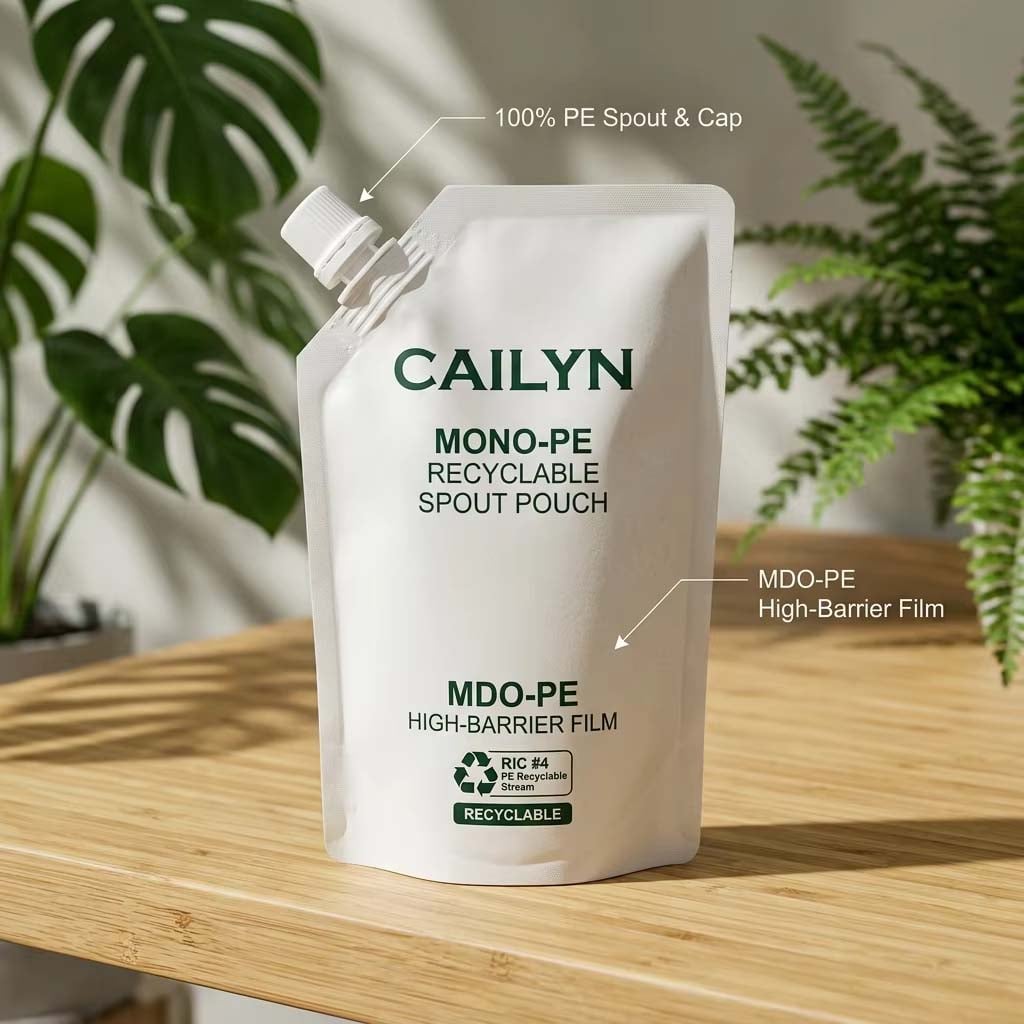
Mono-PE and Mono-PP structures can reduce the complexity created by incompatible polymer combinations. Depending on the application, options may include PE/PE, high-barrier PE/EVOH/PE, Mono-PP, stand-up pouches, flat-bottom bags and rollstock film. However, “mono-material” is not a complete compliance conclusion. The assessment should cover inks, adhesives, barrier layers, zippers, valves, spouts, labels and decorative finishes.
For coffee, tea, supplements, pet food and high-fat snacks, redesign should begin with measurable performance needs such as OTR, WVTR, seal strength, puncture resistance, filling temperature, distribution conditions and target shelf life. In some projects a mono-material high-barrier structure may be suitable; in others a foil or metallised structure may remain necessary until an alternative has been validated.
Paper packaging is not automatically recyclable simply because paper is the main substrate. Plastic lamination, grease-resistant treatments, hot-melt adhesives, metallic foils, windows and non-functional layers can affect recycling performance. A matte lamination or small hot-stamped logo is not automatically prohibited, but unnecessary or incompatible components should be reduced where function and appearance allow.
Brands may evaluate aqueous coatings, carefully selected varnishes, reduced foil coverage, separable components, more efficient box dimensions and fewer decorative layers. For food-contact paper packaging, PFAS evidence should be treated separately from general recyclability claims.
|
Information to request |
Why it matters |
Typical Cailyn support |
|
Material structure and thickness |
Identifies polymers, paper, foil, coatings and barrier layers. |
Structure specification and dimensional data. |
|
PFAS evidence where applicable |
Supports food-contact chemical assessment. |
Supplier declarations and/or test coordination by project. |
|
Heavy-metal evidence |
Covers lead, cadmium, mercury and hexavalent chromium. |
Testing support for selected material systems. |
|
Food-contact documentation |
Supports safety assessment for the intended contact conditions. |
Applicable declarations and migration-test coordination. |
|
Ink, adhesive and coating data |
Captures components not shown by the base-film specification. |
Material and supplier information where available. |
|
Barrier and seal performance |
Confirms product protection and filling-line suitability. |
OTR, WVTR, seal-strength and sampling support. |
|
Batch traceability |
Links finished packaging to production and material records. |
Production and batch records. |
|
Technical-document support |
Helps the responsible operator prepare its conformity file. |
Structured supporting information; final legal role remains supply-chain specific. |
Cailyn approaches PPWR preparation as a combination of material engineering, product protection, production validation and documentation support. We do not assume that one material can solve every packaging application.
1. Packaging structure review. We review the packaged product, current structure, required shelf life, filling and sealing method, storage conditions, dimensions, printing, surface finish and accessories.
2. Alternative material development. Depending on the application, we can evaluate Mono-PE, high-barrier PE/EVOH-based options, Mono-PP, conventional high-barrier laminates, foil or metallised structures, paper formats and compostable options for suitable disposal systems.
3. Testing and technical-information support. By project, Cailyn can support or coordinate material information, food-contact documentation, PFAS evidence, heavy-metal testing, migration testing, residual-solvent testing, OTR/WVTR, seal strength and traceability information.
4. Sampling and filling-line validation. New materials can change heat-sealing temperature, sealing time, machine speed, film stiffness, zipper performance and transport resistance. Physical samples and line trials should be completed before large-volume conversion.
|
Area |
Cailyn packaging support |
Buyer / responsible EU operator |
|
Materials |
Provide structure, component and production information. |
Confirm suitability for the final packaged product and target market. |
|
Chemical evidence |
Support relevant PFAS, heavy-metal and food-contact documentation. |
Determine the required evidence and final acceptance criteria. |
|
Performance |
Support barrier, seal and filling-line evaluation. |
Approve shelf life and final application performance. |
|
Traceability |
Provide batch and production records. |
Maintain the final conformity and market-placement file. |
|
PPWR roles |
Provide supplier-side technical data. |
Identify the responsible manufacturer/importer and DoC signatory. |
|
EPR |
Provide packaging weight and material data. |
Complete national registration, reporting and fee obligations where applicable. |
Explore related Cailyn resources: recyclable PE/PE flexible packaging, food and snack packaging, coffee and tea packaging, and health and supplement packaging.
1. Map current EU packaging. List the structures used for products already entering or planned for the EU market.
2. Prioritise food-contact applications. Review films, papers, coatings and treatments that may require PFAS evidence.
3. Request technical information early. Do not wait until shipment approval to ask for specifications, declarations and reports.
4. Separate present obligations from future design targets. Confirm what applies in 2026 and build a phased plan for later recyclability and minimisation requirements.
5. Validate alternatives before conversion. Test barrier performance, sealability, machine compatibility and shelf life before approving a new structure.
6. Clarify the responsible economic operator. Agree who will prepare the final conformity file and manage EPR obligations in each target market.
Regulation (EU) 2025/40 entered into force on 11 February 2025 and generally applies from 12 August 2026. Several requirements are introduced later through phased dates and additional delegated or implementing acts.
Yes. The PPWR applies to packaging placed on the EU market regardless of origin. Non-EU suppliers should therefore be prepared to provide technical information to the relevant EU economic operator.
No blanket August 2026 ban applies to all laminated flexible pouches. Multi-material structures may, however, face greater challenges under later design-for-recycling criteria.
No. Mono-PE can support design for recycling, but the full package—including barrier layers, inks, adhesives, zippers, valves, labels and intended use—must be assessed.
The business identified as the manufacturer under the PPWR is responsible for the applicable conformity assessment and EU Declaration of Conformity. The correct party depends on the branding, design, filling, import and market-placement arrangement.
Not necessarily. The evidence strategy depends on the materials, coatings, supplier information, risk profile and customer requirements. Appropriate documentation should be agreed before production.
 Hot News
2025-12-05
2026-03-27
2025-12-05
2026-04-08
2025-12-05
2026-08-12
Copyright © Shanghai Cailyn Industrial Co., Ltd All Rights Reserved - Privacy Policy
 EN
EN