
 EN
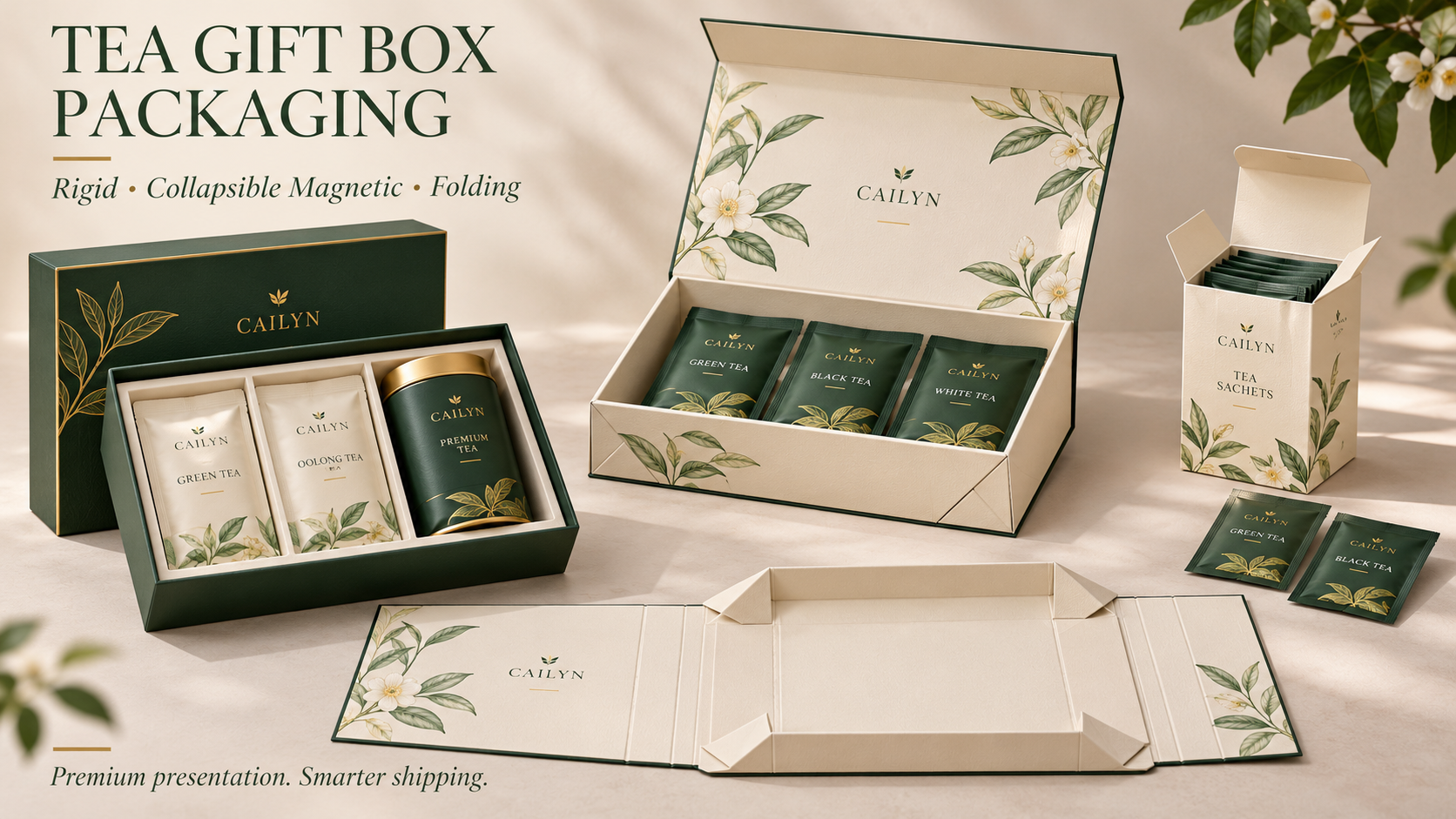
A specialty tea gift set needs to do more than look attractive. Its packaging should hold the contents securely, protect delicate components and create an enjoyable opening experience.
A lightweight collection of tea sachets has different requirements from a set containing metal tins, ceramic cups or glass accessories. Packaging also needs to balance presentation with assembly, storage and shipping costs.
At Cailyn, we develop tea gift packaging as a complete system: the outer box provides structure and presentation, inserts organize and secure the contents, and sealed primary packaging protects the tea.
Separate Structural Protection from Freshness Protection
Each packaging component has a different role.
|
Component |
Main Function |
|
Rigid box, collapsible magnetic box or folding carton |
Presentation, organization and structural support |
|
Internal insert or divider |
Product positioning, separation and cushioning where designed |
|
Sealed tea pouch or individual overwrap |
Moisture, oxygen and aroma protection according to its specification |
|
Shipping carton and transit protection |
Protection during distribution |
A close-fitting lid, sleeve or tuck flap does not make a paper box airtight. Likewise, a metal tea tin should not automatically be assumed to provide a hermetic seal.
The complete set should therefore be developed around both structural requirements and the tea’s storage needs.
Conventional Rigid Tea Gift Boxes
Conventional rigid boxes typically use a paperboard core wrapped in decorative paper. They retain their assembled shape and provide a defined presentation for tea collections and accessory sets.
Common options include:
Lift-off lid boxes.
Book-style boxes with magnetic closures.
Drawer-style rigid boxes.
Shoulder-and-neck boxes.
The right construction depends on the contents, opening experience, order quantity, budget and distribution requirements.
Design for the Actual Load
Board thickness is only one part of structural performance.
Box dimensions, unsupported spans, joints, lid design and the way the contents transfer weight all affect the result. A larger box may need a different construction even when its contents weigh the same as a smaller set.
For sets containing ceramic or glass items, the weight and position of each component should be considered individually.
A well-designed insert should support heavier items appropriately, keeping them from moving against neighboring products or loading an unsupported section of the box.
Consider Storage and Freight Volume
Conventional non-collapsible rigid boxes occupy their assembled volume during storage and shipping.
For customers importing empty packaging and filling it locally, this can increase freight costs and warehouse requirements. The difference can be especially relevant for larger gift boxes or orders shipped by air or courier.
A collapsible structure may offer a more practical alternative when reducing empty-box volume is a priority.
Collapsible Magnetic Tea Gift Boxes
Cailyn offers collapsible magnetic gift boxes that can be shipped flat and assembled before packing.
These boxes combine a rigid-box appearance and magnetic closure with reduced empty-box shipping volume. They can suit tea brands seeking premium presentation while managing freight and storage costs.
Benefits of a Flat-Pack Structure
Reduced shipping volume: Flat-packed boxes occupy less space than comparable fully assembled rigid boxes.
More efficient storage: Customers can store boxes flat and assemble them as needed.
Premium presentation: Printed wraps, magnetic closures and decorative finishes support a refined opening experience.
Flexible packing schedules: Boxes can be assembled close to the time they are needed.
Actual savings depend on box dimensions, packing arrangements, order quantity and shipping method.
Coordinate the Insert with the Box
The insert should be included in the space-saving assessment.
A folding or separately packed insert can help preserve the benefit of a flat-packed outer box. A bulky, preassembled insert may reduce the overall shipping-volume saving.
For sets containing heavy tins, ceramic cups or glass accessories, the assembled box, corner connections and insert system should be evaluated together.
Assembly time should also be considered. Physical samples allow customers to check how easily the box forms, how securely it holds its shape and how it performs with the contents inside.
Folding Tea Cartons
Folding cartons are made from die-cut and creased paperboard. Many designs can be supplied flat, helping reduce storage and transport space before assembly.
They can suit:
Individually wrapped tea-bag collections.
Small loose-leaf tea pouches.
Retail gift assortments.
Sleeves for trays or tins.
Seasonal and promotional sets.
Suitability depends on the board grade, dimensions, closure construction, inserts and intended load.
Match the Base to the Contents
The bottom construction deserves particular attention when a carton holds several products or heavier components.
Tuck-bottom, crash-lock and other constructions have different assembly and loading characteristics. The appropriate option should be confirmed with a physical sample.
If the contents are too heavy for the proposed construction, a reinforced design, corrugated component or rigid structure may be more appropriate.
Comparing Tea Gift Box Structures
|
Box Type |
Main Advantages |
Points to Consider |
|
Conventional rigid box |
Defined structure, assembled delivery and premium presentation |
Higher empty-box storage and shipping volume |
|
Collapsible magnetic box |
Premium appearance with flat-pack delivery |
Requires assembly; connections, inserts and load support need coordinated design |
|
Folding carton |
Flat storage, flexible formats and efficient production |
Board grade, base construction and inserts must suit the contents |
These are general comparisons rather than performance guarantees. The final choice should be based on samples, the actual contents and the intended distribution method.
Protective Inserts: Secure the Contents
An insert should hold products in position while allowing customers to remove them comfortably.
|
Insert Option |
Potential Applications |
Design Considerations |
|
Folding paperboard insert |
Tea sachets, small pouches and lightweight tins |
Cutout fit, support tabs and assembly |
|
Corrugated insert |
Heavier tins, accessories and transit support |
Load direction, edge contact and appearance |
|
Molded pulp insert |
Shaped support for suitable products |
Tooling, fit, surface finish and cushioning performance |
|
Foam insert |
Selected fragile or premium components |
Material suitability, odor, fit and end-of-life requirements |
Material choice should reflect the actual product. A decorative paperboard divider may organize tea sachets well but provide insufficient protection for a ceramic cup.
For fragile items, check clearances, contact points and protection against movement in all relevant directions.
Aroma Protection Comes from the Inner Packaging
Ordinary paperboard boxes and decorative finishes are not substitutes for sealed barrier packaging.
For loose-leaf tea, a suitable inner pouch can provide protection from moisture, oxygen and external odors. For brewing tea bags, individual sealed overwraps can serve this role.
The filter bag itself is porous so that water can pass through during brewing. It should not be treated as the moisture or oxygen barrier.
Keep Different Tea Aromas Separate
Gift sets may combine jasmine tea, roasted oolong, bergamot-flavored blends or other strongly scented products.
Paperboard dividers keep products physically separated, but do not reliably prevent aroma transfer. Individually sealed packs with suitable barrier performance are a more appropriate starting point.
Each variety should be evaluated according to its sensitivity, target shelf life and packing method.
Check Tins as Part of the System
A tea tin can provide presentation and convenient storage, but its protective performance depends on its closure and construction.
Where required, a sealed inner pouch can be used inside the tin. This separates initial freshness protection from the reusable outer container.
The decision should follow the complete specification rather than the appearance of the tin alone.
Match the Inner Pack to the Tea
Different teas bring different packaging priorities.
Matcha powder: Consider oxygen, moisture and light protection, together with powder handling and clean sealing areas.
Green tea: Consider fresh aroma, color and protection from unsuitable light, oxygen and temperature exposure.
Black tea and roasted oolong: Consider moisture protection, aroma retention and prevention of external odor transfer.
Scented teas and herbal blends: Consider aroma separation and the characteristics of the actual ingredients.
Delicate whole leaves and dried flowers: Allow suitable space and protection from crushing.
An opaque barrier pouch, transparent high-barrier pack or individual overwrap may each suit a different project. No outer gift box alone guarantees a particular shelf life.
Combining Structures in One Tea Gift Set
A gift set can combine several constructions.
A conventional rigid box can hold folding paperboard compartments. A collapsible magnetic box can be paired with a flat-packed insert. A folding carton can contain individually sealed sachets arranged in a fitted tray.
Developing these components together helps coordinate fit, assembly and presentation.
It also allows structural support to be placed where it is needed while controlling material use and packing complexity.
Printing and Finishing for Tea Gift Boxes
Printing methods should be selected for the paper substrate, artwork, quantity and finishing requirements.
Paper box projects may use offset or digital printing, while sleeves, labels and flexible inner packs can require different production processes.
Finishing options may include:
Matte or gloss finishes.
Foil stamping.
Embossing or debossing.
Spot UV.
Textured wrapping papers.
These finishes support the visual design, but should not be presented as evidence of load-bearing strength or aroma protection.
Color and finish should be approved using appropriate references and samples, especially when coordinating paper boxes, labels, tins and flexible pouches across different surfaces.
Consider Odor as Well as Appearance
Tea gift packaging should not introduce unwanted smells into the set.
Paper, inks, adhesives, coatings and inserts should be selected and processed appropriately. Finished samples should be checked for unwanted odor, particularly when the set has a tightly enclosed interior.
Low odor does not by itself establish food-contact suitability. Any component intended for direct contact with tea requires a specification suitable for that use.
Plan for Shipping and Assembly
A decorative gift box is not necessarily a shipping container.
For courier delivery or export distribution, the finished set may need a separate corrugated carton, cushioning and a suitable packing arrangement.
It is also important to distinguish between two shipping stages:
Empty packaging delivery: Flat-packed magnetic boxes and folding cartons can reduce volume before filling.
Finished gift-set delivery: Once assembled and filled, the complete set needs suitable transit protection.
Before production, evaluate samples with the actual contents or representative equivalents. Checks may include:
Fit and movement within the insert.
Assembly time and ease of packing.
Lifting and handling of the filled set.
Closure operation and repeated opening.
Compression or stacking under agreed conditions.
Drop or transit evaluation suited to the distribution route.
Inspection for breakage, scuffing and component displacement.
Performance claims should relate to the tested construction, contents and conditions.
Sustainability: Simplify Where Practical
A paper-based appearance does not automatically mean the complete gift set is recyclable.
Laminations, magnets, ribbons, foam and mixed-material components can affect disposal and separation. Where suitable, paperboard or corrugated inserts and removable accessories can simplify the design.
Material choices should be assessed against product protection, destination-market requirements and available collection systems.
Avoiding oversized boxes can reduce material use and shipping volume. Flat-packed delivery can also improve transport efficiency before assembly, although it does not by itself establish an environmental claim.
What to Share Before Developing a Tea Gift Box
To prepare a practical proposal, Cailyn needs:
The number and type of products in the set.
Dimensions and weight of each component.
Details of fragile items, such as cups or glass containers.
Existing or proposed primary tea packaging.
Preferred box style and opening experience.
Whether boxes should arrive assembled or flat-packed.
Artwork, finishes and reference designs.
Order quantity and target budget.
Assembly, delivery and shipping requirements.
Dimensions can be provided in millimeters or inches. The final drawing should distinguish internal usable dimensions from external box dimensions.
Custom Tea Gift Packaging from Cailyn
Cailyn helps tea brands coordinate gift boxes, inserts, sealed tea pouches, individual overwraps and labels within one packaging project.
Options include conventional rigid boxes, collapsible magnetic boxes and folding cartons, with structures developed around the contents, presentation and distribution requirements.
Whether you are creating a compact tea-bag assortment or a premium collection with tins and accessories, our team can help balance product protection, appearance, assembly and freight volume.
Share your product list, dimensions, weights, design ideas and order quantity with Cailyn. Let us know whether you prefer assembled or flat-packed delivery so we can recommend a suitable tea gift packaging solution and arrange samples for evaluation.
Table of Contents
- Separate Structural Protection from Freshness Protection
- Conventional Rigid Tea Gift Boxes
- Collapsible Magnetic Tea Gift Boxes
- Folding Tea Cartons
- Comparing Tea Gift Box Structures
- Protective Inserts: Secure the Contents
- Aroma Protection Comes from the Inner Packaging
- Match the Inner Pack to the Tea
- Combining Structures in One Tea Gift Set
- Printing and Finishing for Tea Gift Boxes
- Consider Odor as Well as Appearance
- Plan for Shipping and Assembly
- Sustainability: Simplify Where Practical
- What to Share Before Developing a Tea Gift Box
- Custom Tea Gift Packaging from Cailyn