
 EN
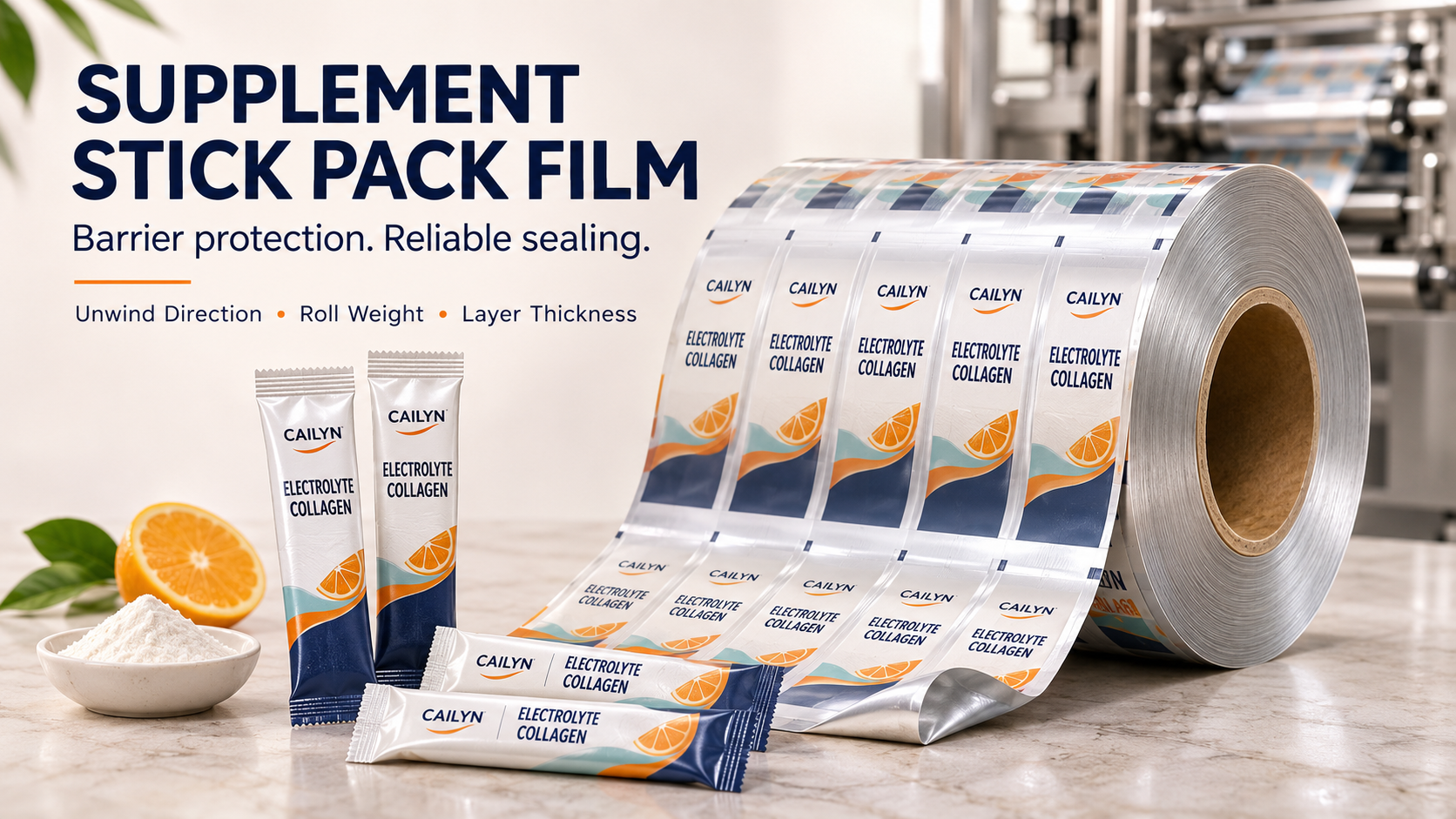
Single-serve stick packs offer a convenient format for electrolyte powders, collagen, powdered vitamins and other supplement blends.
Successful packaging depends on more than attractive printing. The rollstock film must protect the product, form correctly on the filling equipment, seal consistently and open conveniently for the consumer.
At Cailyn, we develop custom printed rollstock around the product and the customer’s packaging process. Before production, we pay particular attention to unwind direction, the equipment’s permitted roll weight and the thickness of each material layer.
This guide explains the specifications that matter—from barrier performance and puncture resistance to roll configuration and production trials.
How Rollstock Becomes a Stick Pack
Stick pack equipment forms, fills and seals packages from a continuous roll of flexible film.
Depending on the machine, a wider web may be slit into several lanes before being formed into individual packs. Film dimensions, artwork layout and seal configuration must therefore match the equipment.
A suitable film needs to balance:
Product protection.
Mechanical durability.
Heat-sealing performance.
Friction and handling characteristics.
Print registration.
Roll quality.
Opening convenience.
These properties should be assessed together rather than selecting the film by total thickness alone.
Start with the Supplement Formula
Different powders present different packaging challenges.
A fine, dusty blend may contaminate the sealing area. A moisture-sensitive formula may clump during storage. A product containing coarse particles may require closer evaluation for abrasion and handling damage.
Before recommending materials, Cailyn considers:
Ingredients and product form.
Fill weight and bulk density.
Moisture and oxygen sensitivity.
Powder flow and dust generation.
Particle size and texture.
Target shelf life.
Storage and distribution conditions.
Filling equipment and intended output.
The same laminate should not automatically be used for every supplement simply because the products share a stick pack format.
Barrier Protection: Moisture, Oxygen and Light
Moisture Protection
Some supplement blends readily absorb moisture. This can affect flow, appearance and the consumer’s ability to empty the pack.
The required moisture barrier should reflect the actual formula, storage environment and shelf-life target.
Oxygen and Light Protection
Certain ingredients may also require protection from oxygen or light.
An opaque structure may be appropriate where light protection is important. A transparent high-barrier structure should be assessed separately for oxygen, moisture and light performance.
No film alone guarantees a specific shelf life. Product condition, residual oxygen, sealing and storage all contribute.
Compare Barrier Data Under Matching Conditions
Oxygen transmission rate, or OTR, and water vapor transmission rate, or WVTR, can help compare candidate materials.
Figures should be reviewed under the same test conditions. Temperature, humidity and test methods affect how results should be interpreted.
Finished-pack performance also depends on seals, folds and handling—not only a flat film sample’s barrier value.
Material Structures for Supplement Stick Packs
Candidate laminates may include:
|
Structure Example |
Potential Role |
What to Confirm |
|
PET/PE |
Printable outer film with a heat-sealing layer |
Whether its barrier and mechanical performance meet the application |
|
PET/VMPET/PE |
Metallized barrier structure |
Required moisture and oxygen protection, flexing and sealing performance |
|
PET/AL/PE |
Opaque foil-based barrier structure |
Foil durability, opening behavior and machine compatibility |
|
Structures incorporating PA or NY |
Additional toughness where appropriate |
Moisture response, stiffness, curl and suitability for the equipment |
|
Suitable mono-material structures |
An option for projects with specific recycling objectives |
Barrier, heat resistance, sealing and destination-market requirements |
These are development options, not interchangeable specifications.
The complete laminate, individual layer thicknesses and sealant grade should be selected around the product and machine trial results.
Why Individual Layer Thicknesses Matter
Two laminates with the same total thickness can behave differently on a filling line.
The thickness of the outer film, barrier layer and inner sealant each contributes to the finished material’s properties. Changing their proportions can affect stiffness, flexibility, heat transfer, sealing behavior and handling durability.
At Cailyn, we confirm the material and thickness of each layer rather than relying only on a total-thickness figure.
The specification can record layer thicknesses in micrometers, with imperial equivalents where required. For reference, 1 mil equals 25.4 micrometers.
Any proposed material substitution should be reviewed for both product protection and equipment compatibility before production.
Puncture Resistance and Handling Durability
Not every supplement powder presents a significant puncture risk. The need for reinforcement should follow the product and expected handling conditions.
Coarse or hard particles, tight packing, repeated flexing and external contact can place stress on the package.
Relevant properties may include:
Puncture resistance.
Tear resistance.
Lamination bond strength.
Resistance to flex cracking.
Seal strength.
Protection from downstream handling damage.
A thicker or stiffer film is not automatically the best solution. Layer selection and the complete package design matter.
For foil-based structures, barrier integrity after forming and handling should also be considered. An undamaged flat sample does not necessarily represent the performance of the finished pack.
Seal Performance: A Priority for Powder Products
A strong laminate cannot compensate for an unreliable seal.
Sealing performance depends on the sealant, jaw design, temperature, pressure and available contact time.
Sealing Window
A suitable operating window helps the line produce consistent seals under the intended conditions.
The target should be established with the actual machine and laminate. Increasing temperature alone may not solve weak seals and can introduce distortion or other problems.
Hot Tack
At higher production rates, the seal may be stressed before it has fully cooled.
Hot-tack performance—the ability of a freshly formed seal to resist opening while still hot—can therefore be relevant to film selection.
Powder in the Sealing Area
Fine powders can settle in the sealing area and interfere with closure integrity.
Sealant selection should be considered alongside dosing accuracy, product settling time, dust control and sealing-jaw maintenance. A film should not be described as able to seal through any amount of powder.
Trial packs should be checked for channels, incomplete seals and leakage using suitable agreed methods.
Machine Compatibility: More Than Running Fast
Reliable output depends on stable feeding, forming, filling and sealing.
Controlled Coefficient of Friction
The coefficient of friction, or COF, affects how film interacts with itself and machine surfaces.
The aim is an appropriate, consistent friction range—not the lowest possible value. Excessive or insufficient slip can create different handling problems.
Inner and outer surfaces may require separate consideration.
Thickness, Flatness and Curl
Thickness variation, curl and poor flatness can affect tracking, forming and seal alignment.
These properties should be controlled within agreed tolerances and evaluated under production conditions.
Print Registration
Registration marks must be compatible with the customer’s sensor and artwork layout.
Mark dimensions, contrast and position should be confirmed, particularly when using reflective, transparent or heavily printed backgrounds.
Winding and Roll Quality
Consistent winding helps the roll unwind predictably.
Roll hardness, edge alignment, telescoping, core condition and splices should be included in the specification.
Where splices are permitted, agree on their maximum number, joining method and identification. If splice-free rolls are required, confirm this before production.
What Cailyn Confirms Before Rollstock Production
Before production, Cailyn pays particular attention to three specifications that affect compatibility with the customer’s filling equipment.
1. Unwind Direction
We confirm unwind direction using a diagram showing artwork orientation, the leading edge and the position of the sealant side.
This helps ensure the film feeds correctly and the printed design appears in the intended orientation after forming.
A written description alone can be ambiguous, so an approved unwind diagram is preferable.
2. Equipment Roll-Weight Capacity
We confirm the equipment’s permitted roll weight alongside its maximum roll diameter and core requirements.
Roll length and finished roll dimensions are then planned within these limits to avoid exceeding the unwind unit’s load capacity.
A larger roll may reduce changeovers, but it must remain compatible with the machine and the customer’s roll-handling arrangements.
3. Thickness of Each Material Layer
We confirm the material and thickness of each layer, together with the total laminate thickness.
The layer combination is reviewed against the required barrier, durability, forming and sealing performance.
These specifications are agreed before production. A sample-roll trial can then help confirm performance with the actual product and operating settings.
Roll Specifications to Confirm Before Ordering
The machine specification should guide the roll configuration.
|
Item |
Details to Confirm |
|
Machine model |
Manufacturer, model and relevant film requirements |
|
Film width |
Master-web width or individual reel width, as applicable |
|
Print repeat |
Repeat length matched to the approved artwork and machine setup |
|
Lane layout |
Number of lanes and artwork arrangement |
|
Layer structure and thickness |
Material and thickness of each layer, plus total laminate thickness |
|
Core requirements |
Internal diameter, material and compatibility with the unwind shaft |
|
Maximum roll weight |
Permitted load on the unwind unit |
|
Maximum roll diameter |
Permitted outside diameter, with roll length planned accordingly |
|
Unwind direction |
Approved diagram showing artwork orientation, leading edge and sealant side |
|
Seal configuration |
Fin seal, lap seal or other required construction |
|
Registration marks |
Size, color, contrast and position |
|
Splices |
Permitted quantity, joining method and marking |
|
Tolerances |
Agreed width, repeat and other relevant limits |
A lap seal and a fin seal do not necessarily use the same sealing surfaces. The laminate must be compatible with the specified construction.
Specifications can be recorded in both metric and imperial units. For example, a 76.2mm core equals 3 inches, but the required core must be confirmed with the equipment supplier rather than assumed.
Easy Opening Without Compromising Protection
Consumers should be able to open the pack and dispense the powder conveniently.
Opening performance depends on the laminate, tear direction and any notch, scoring or easy-tear feature.
A tear notch may be produced by the packaging machine rather than supplied in the roll itself. Responsibilities should be confirmed during development.
Laser scoring, where suitable, must be designed and evaluated so it does not compromise the required barrier or pack strength.
Custom Printing for Supplement Brands
Cailyn offers printing options for different order requirements.
Digital printing can suit shorter runs, multiple designs and product launches. Rotogravure printing can suit larger production runs, with spot-color matching based on approved references.
Artwork development should account for:
- Lane arrangement and slit positions.
- Longitudinal and end-seal areas.
- Registration marks.
- Variable coding space.
- White-ink coverage and metallic effects.
- Text orientation after forming.
- The opening and dispensing area.
Critical text should remain clear of seals and cut lines, following the approved dieline and equipment tolerances.
Confirm Performance with a Production Trial
A sample-roll trial helps establish whether the proposed film works with the actual formula and equipment.
The trial should assess:
- Roll installation and compatibility with the unwind unit.
- Unwinding and web tracking.
- Slitting and forming, where applicable.
- Filling consistency and powder behavior.
- Seal appearance and integrity
- Registration and cutting accuracy.
- Opening and dispensing.
- Finished-pack handling durability.
- Output and material waste under agreed conditions.
Record sealing settings, production speed and any adjustments.
For multi-lane equipment, distinguish between packs per minute per lane and total machine output. Agreed operating results should relate to the tested film, product and settings.
Sustainability and Material Changes
Alternative structures should be evaluated against both product protection and machine performance.
A material change may require adjustments to sealing conditions, friction targets, opening features or line speed.
Recyclability claims should reflect the complete structure and the collection systems available in the destination market.
A successful change needs to preserve the required shelf life and production reliability.
Custom Stick Pack Rollstock from Cailyn
Cailyn supplies custom printed flexible packaging rollstock developed around your product, artwork and equipment requirements.
Before production, we confirm key details—including unwind direction, equipment roll-weight capacity and individual layer thicknesses—to support compatibility with your filling line.
To begin, share your supplement type, fill weight, target shelf life, machine model, roll specifications, artwork and order quantity.
Contact Cailyn to discuss material options and arrange a sample roll for evaluation on your filling line.
Table of Contents
- How Rollstock Becomes a Stick Pack
- Start with the Supplement Formula
- Barrier Protection: Moisture, Oxygen and Light
- Material Structures for Supplement Stick Packs
- Why Individual Layer Thicknesses Matter
- Puncture Resistance and Handling Durability
- Seal Performance: A Priority for Powder Products
- Machine Compatibility: More Than Running Fast
- What Cailyn Confirms Before Rollstock Production
- Roll Specifications to Confirm Before Ordering
- Easy Opening Without Compromising Protection
- Custom Printing for Supplement Brands
- Confirm Performance with a Production Trial
- Sustainability and Material Changes
- Custom Stick Pack Rollstock from Cailyn