
 EN
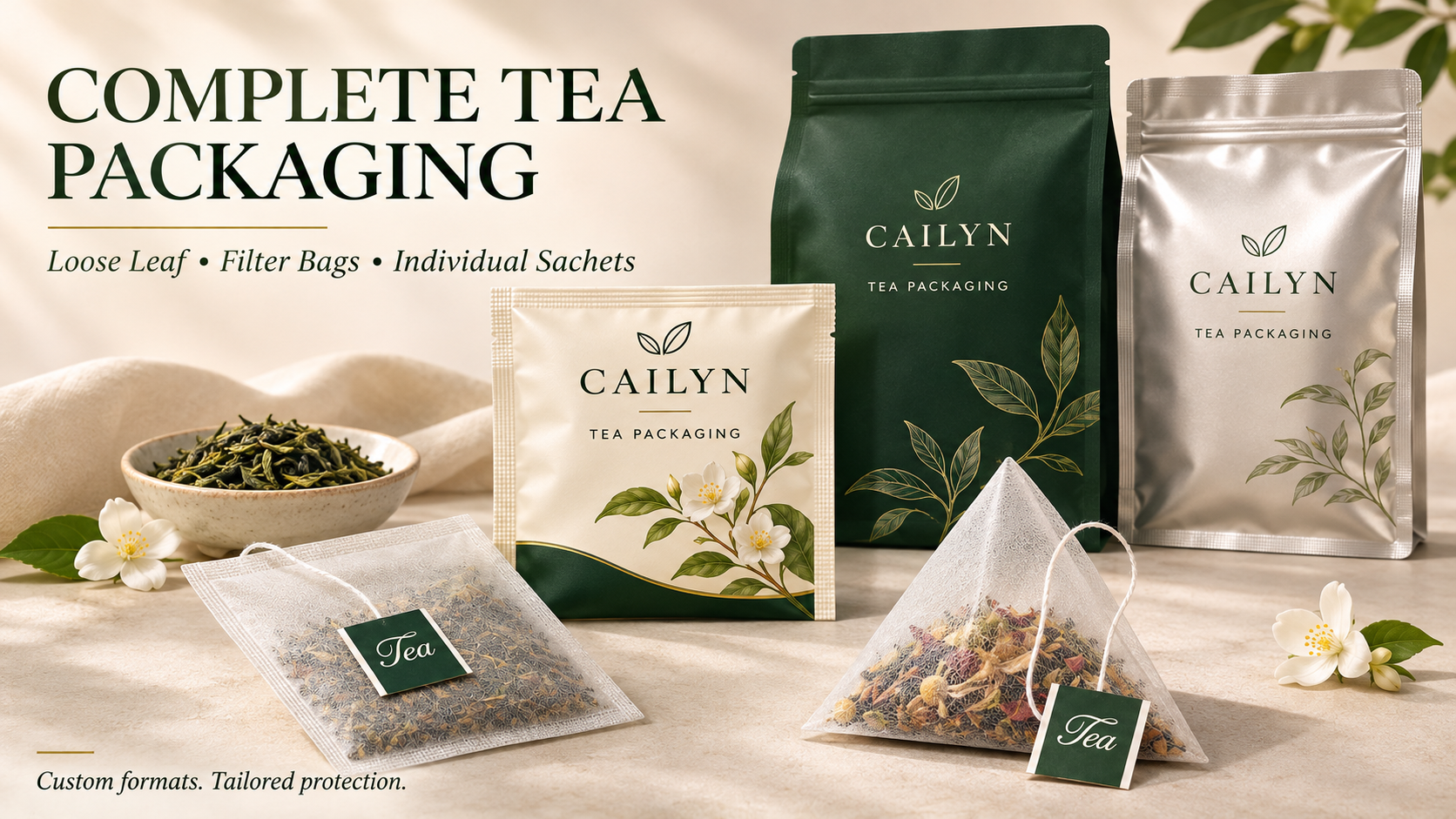
Tea packaging should be selected around the product inside. Matcha powder, green tea, black tea, oolong and floral blends do not all have the same storage and handling requirements.
Some products need particular attention to color and oxygen protection. Others require greater focus on aroma retention, protection from external odors or preventing delicate leaves and petals from being crushed.
At Cailyn, we consider these differences alongside your target shelf life, storage conditions, filling process and brand design to develop suitable custom tea packaging.
What Does Tea Packaging Need to Protect Against?
Moisture
Dried tea can absorb moisture from its surroundings. Moisture uptake can affect quality, cause powders to clump and, under unsuitable conditions, increase the risk of spoilage.
Packaging should provide appropriate moisture protection for the intended storage period, particularly when products travel through humid environments.
Oxygen
Oxygen exposure can contribute to changes in tea color, aroma and flavor. Sensitivity varies with the product and its processing.
A suitable oxygen barrier helps limit exposure, but the oxygen remaining inside the package after filling also matters.
Light and Heat
Light and elevated temperatures can accelerate unwanted quality changes. For products where green color and fresh flavor are important, these factors deserve particular attention.
A transparent film may provide good oxygen protection without providing adequate light protection. Barrier properties should therefore be assessed separately.
External Odors and Aroma Loss
Tea can pick up unwanted odors, while its own volatile aroma compounds can be lost during storage.
Material selection, seal quality and storage away from strongly scented goods all contribute to maintaining the intended sensory experience.
Different Teas Need Different Packaging Priorities
The following comparisons are starting points for packaging development, rather than fixed material specifications.
|
Tea Type |
Main Protection Priorities |
Packaging Considerations |
|
Matcha powder |
Color, aroma, moisture protection and oxygen control |
Opaque high-barrier structures, appropriate portion sizes and clean sealing areas |
|
Green tea |
Fresh aroma, color and protection from oxygen, light and heat |
Suitable oxygen and moisture barriers, light protection and confirmed storage conditions |
|
Black tea |
Moisture protection, aroma retention and prevention of odor transfer |
Reliable seals and barrier performance matched to storage and distribution |
|
Lightly roasted or lightly oxidized oolong |
Fresh fragrance and protection from unwanted aroma changes |
Oxygen protection, aroma retention and packing methods suited to the leaf |
|
Heavily roasted oolong |
Roasted aroma, dryness and protection from external odors |
Moisture protection, seal integrity and protection of whole leaves during handling |
|
Jasmine and other scented teas |
Retention of floral fragrance and prevention of odor transfer |
Suitable aroma protection and careful material and storage selection |
|
Dried flowers and herbal blends |
Moisture protection, color, aroma and protection from crushing |
Specifications based on the actual ingredients, with suitable space and outer protection |
Matcha Powder: More Than a Barrier-Material Decision
Matcha needs attention to both storage protection and powder handling.
An opaque high-barrier package can help limit oxygen, moisture and light exposure. Smaller sealed portions may also be useful when customers consume the product slowly, reducing repeated exposure of the remaining powder.
During filling, powder should be kept away from the final heat-sealing area. Residue in the seal can interfere with closure integrity. Zipper design and opening size should also be practical for filling and scooping.
Storage instructions should follow the tea producer’s validated recommendations. If refrigeration is specified, the instructions should address condensation and odor protection. Cold packaging should be allowed to reach room temperature while still sealed before opening.
Green Tea: Protecting Freshness and Color
For green tea, packaging development should consider fresh aroma and color alongside moisture protection.
Opaque structures can help reduce light exposure. Where customers prefer transparent packaging, the effect of display lighting and the use of an outer box should be considered.
Any low-temperature storage or distribution requirement should be confirmed with the tea producer. Packaging alone cannot compensate for unsuitable temperatures.
Black Tea: Still Requires Effective Protection
Black tea’s processing does not remove the need for protective packaging.
Moisture, external odors and aroma changes remain relevant during storage. The structure should be selected according to the product, target shelf life and distribution environment rather than assuming that all black teas need the same protection.
Oolong: Processing and Leaf Shape Both Matter
Oolong covers a wide range of oxidation and roasting styles. A fragrant, lightly roasted tea and a heavily roasted tea may have different quality priorities.
The physical form also affects packaging. Tightly rolled leaves and long, delicate strips occupy space differently and respond differently to compression.
Vacuum packing should not be treated as a universal choice. Its suitability depends on the tea, desired presentation and risk of damaging the leaves.
Floral Teas and Herbal Blends: Specify the Actual Product
Jasmine-scented tea and a blend of dried flowers are different products.
A scented tea may place particular emphasis on preserving fragrance, while a blend containing petals, fruit pieces or herbs also needs evaluation for moisture sensitivity, ingredient characteristics and physical protection.
For delicate blends, suitable internal space and an outer box may be as important as the film structure.
How Multi-Layer High-Barrier Packaging Works
Different materials serve different functions. A laminated structure combines these functions within one package.
A typical structure may include:
An outer layer for printing, appearance and mechanical protection.
A barrier layer to help control oxygen, moisture or light exposure.
An inner sealant layer for food contact and heat sealing.
More layers do not automatically mean better performance. Material grades, thicknesses, manufacturing quality and finished-package integrity determine whether a structure suits the application.
Common Material Options for Tea Packaging
Aluminum Foil Laminates
Structures such as PET/AL/PE can be considered when strong oxygen, moisture and light protection is required.
They can suit opaque packaging for matcha, green tea and other products where visibility is not essential. The complete specification should also account for handling and flexing during distribution.
Metallized Film Laminates
Structures such as PET/VMPET/PE can offer a balance between barrier performance, appearance and cost.
Performance depends on the film grade, metallization quality and laminate construction. Metallized film should not be treated as interchangeable with aluminum foil simply because both have a silver appearance.
Transparent High-Barrier Structures
For customers who want to display the tea, suitable transparent structures incorporating EVOH can be considered.
These can provide oxygen protection while retaining visibility. The complete laminate must also address moisture protection and the intended humidity conditions.
Transparent high-barrier packaging does not provide the same light protection as an opaque structure. A smaller window, protective outer box or different display arrangement may be appropriate.
Matte and Paper-Look Finishes
Matte or paper-look surfaces can create a natural, understated appearance. However, the surface finish does not establish barrier performance.
The underlying structure still needs to match the tea’s storage requirements. Visual style and protective function should be developed together.
Compare Performance, Not Just Material Names
A material description is a starting point rather than a complete specification.
|
Specification |
What It Helps Assess |
|
Oxygen transmission rate, or OTR |
Oxygen passage through the material |
|
Water vapor transmission rate, or WVTR |
Moisture passage through the material |
|
Light protection |
Suitability for light-sensitive products |
|
Seal performance |
Reliability of the finished closure |
|
Mechanical performance |
Resistance to handling damage |
|
Food-contact suitability |
Suitability for the intended application |
OTR and WVTR figures should be compared under the same test conditions. Temperature, humidity and test methods affect how results are interpreted.
Finished-package performance also depends on seals, folds, accessories and handling—not only the barrier value of a flat film sample.
Choose Dimensions Around the Actual Tea
Tea capacity cannot be determined from weight alone.
Rolled tea, fluffy whole leaves, matcha powder and blends containing flowers can occupy very different volumes at the same net weight. Coffee bag capacity charts should therefore not be used as fixed tea-packaging specifications.
Even within one bag style, customers may prefer different proportions. A conventional upright flat-bottom bag and a wider format require different dimensions, while stand-up pouches use another construction.
At Cailyn, we customize width, height and gusset or bottom depth around the actual product, design and filling process. Specifications can be provided in both millimeters and inches.
Trial filling helps confirm capacity, opening clearance and space for the final heat seal before production.
Select the Format for the Way Customers Use the Tea
Stand-Up Pouches
Stand-up pouches provide a broad front panel and can include a zipper for convenient reclosure. They can suit retail tea, powders and refill products when appropriately specified.
Flat-Bottom Bags
Flat-bottom bags provide a defined base and multiple display panels. Upright and wider formats can be developed around different brand styles.
Side-Gusset and Quad-Seal Bags
These formats can be considered for retail or larger refill quantities, depending on the desired presentation and filling process.
Small Inner Sachets and Outer Boxes
Smaller sealed portions can reduce repeated exposure of the remaining product after opening.
For gift sets, inner packs can provide product protection while the outer box adds presentation, organization and space for brand communication.
Reclosure Is Different from the Original Seal
A zipper makes a bag convenient to close after opening, but it should not be treated as equivalent to the original sealed package.
The initial heat seal is an important part of the protective system. After opening, repeated exposure to air, humidity and external odors affects the product.
The opening should also suit the contents. Matcha needs convenient filling and scooping, while larger leaves and petals need sufficient clearance to avoid unnecessary damage.
For slow consumption, smaller packs may be more practical than one large bag, even when both use high-barrier materials.
Match the Specification to the Target Shelf Life
Before recommending a structure, Cailyn considers:
- Tea type, processing and physical form.
- Target shelf life before opening.
- Expected use after opening.
- Storage temperature and humidity.
- Light exposure during display.
- Shipping and distribution conditions.
- Filling method and any protective-atmosphere requirements.
- Preferred transparency, finish and budget.
No laminate alone guarantees a specific shelf life. Product condition, filling conditions, residual oxygen, sealing and storage all contribute.
Evaluation using the actual tea and proposed packaging helps confirm whether the specification meets the brand’s requirements.
Sustainability: Assess the Complete Package
Recyclable mono-material structures and other material options can be considered alongside the required protective performance.
The assessment should include accessories, the destination market and available collection systems.
A multi-layer structure is not automatically recyclable, and a bio-based material is not automatically recyclable or compostable. Environmental claims should match the complete specification and supporting evidence.
The aim is to provide appropriate protection without unnecessary material or unsupported claims.
Custom Tea Packaging from Cailyn
Cailyn develops tea packaging around the product inside—from fine matcha powder to whole-leaf oolong and delicate floral blends.
Our options include stand-up pouches, flat-bottom bags, side-gusset bags, quad-seal bags, inner sachets, printed boxes and labels. Materials, dimensions, closures and finishes can be customized to balance product protection and brand presentation.
Share your tea type, target filling weight, expected shelf life, storage conditions, preferred design and order quantity with Cailyn. Our team can help you compare options and arrange samples for evaluation.
Table of Contents
- What Does Tea Packaging Need to Protect Against?
- Different Teas Need Different Packaging Priorities
- How Multi-Layer High-Barrier Packaging Works
- Common Material Options for Tea Packaging
- Compare Performance, Not Just Material Names
- Choose Dimensions Around the Actual Tea
- Select the Format for the Way Customers Use the Tea
- Reclosure Is Different from the Original Seal
- Match the Specification to the Target Shelf Life
- Sustainability: Assess the Complete Package
- Custom Tea Packaging from Cailyn