
 EN
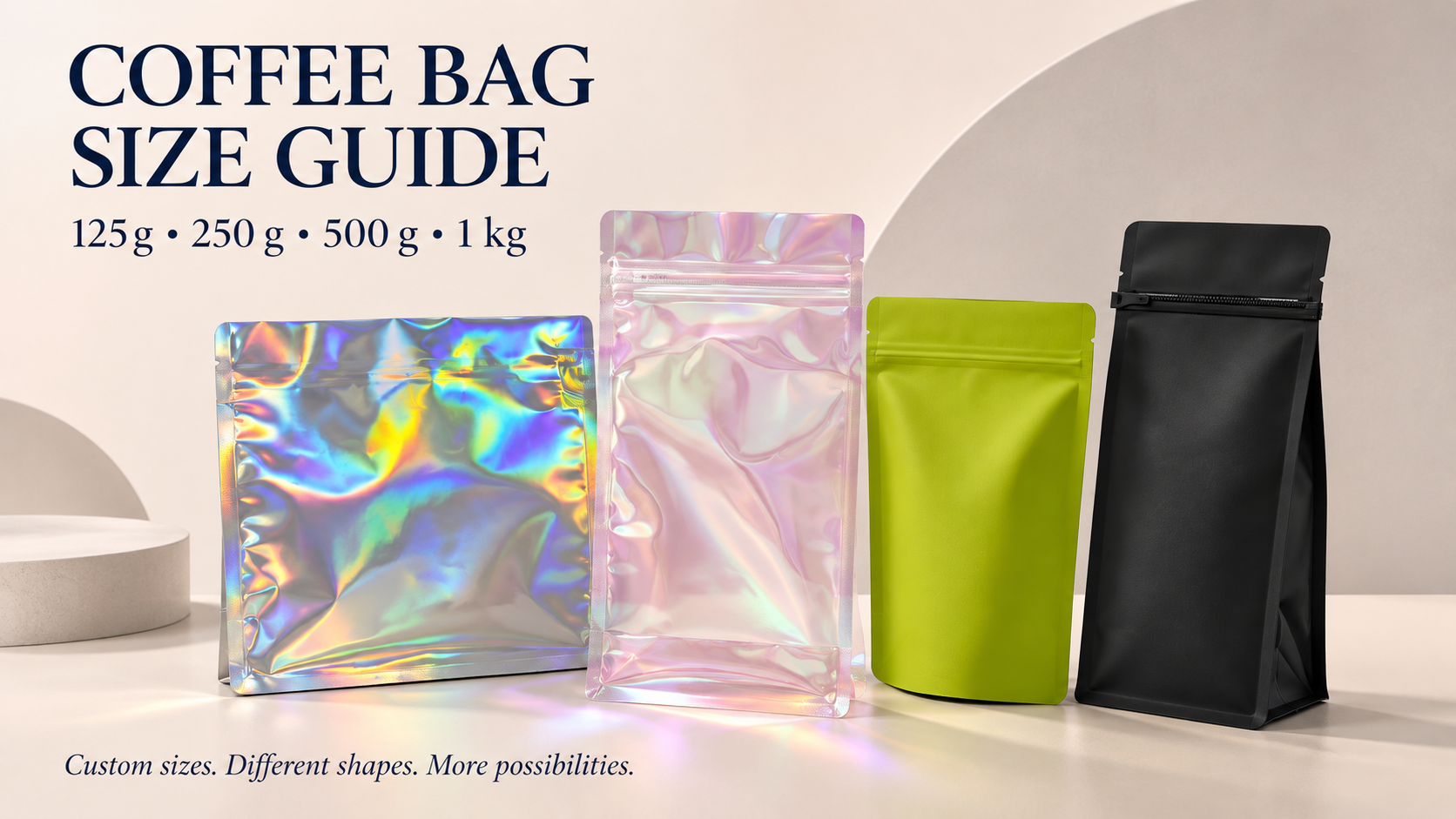
Choosing the right coffee bag starts with your product, your customers and the way you want your brand to look.
A compact tasting pack, a wide-format retail bag and a larger café pack serve different purposes. Even at the same filling weight, each can use different dimensions, materials and closure designs.
This guide compares common coffee pack weights and provides reference dimensions for standard flat-bottom bags, wide-format flat-bottom bags and stand-up pouches. At Cailyn, these sizes are starting points for customization—not limits on what you can create.
Coffee Bag Sizes Are References, Not Fixed Standards
A “250g coffee bag” describes its intended filling weight, not a universal width and height.
The same amount of coffee can fit into different bag shapes. Some brands prefer a tall, slim profile, while others choose a wider, lower-profile design with more space across the front panel.
Even within flat-bottom coffee bags, conventional upright and wide-format styles use different dimensions. Stand-up pouches have a different construction and should be specified separately.
In Cailyn’s filling trials, whole beans and ground coffee at the same net weight required similar bag capacity. A single specification can therefore often accommodate both, with the final fit confirmed using the customer’s actual coffee.
We customize bag width, height and gusset or bottom depth to suit your design, filling process and target capacity. Sizes smaller or larger than those shown below can also be developed.
Common Coffee Pack Weights: Metric and Imperial
|
Metric Net Weight |
Approximate Imperial Equivalent |
Typical Applications |
|
125g |
4.4oz / 0.28lb |
Trial purchases, tasting sets and gifts |
|
250g |
8.8oz / 0.55lb |
Specialty retail and subscriptions |
|
500g |
17.6oz / 1.10lb |
Frequent home brewing and shared households |
|
1kg |
35.3oz / 2.20lb |
Cafés, offices and wholesale supply |
If your market uses imperial pack weights, specify those quantities directly. For example, 8oz is approximately 227g, 12oz is 340g, 1lb is 454g and 2lb is 907g.
A 250g pack is not the same as an 8oz pack, and a 500g pack is not the same as a 1lb pack. Confirm the intended net weight when requesting samples or quotations.
Coffee Bag Reference Dimensions by Style
The following dimensions are suggested references for the individual bag styles shown. They are not fixed standards or guaranteed filling capacities.
The same net weight may use a different size depending on the bag proportions, closure position, usable filling space and customer’s design preferences. Final specifications should be confirmed with samples before production.
Standard Flat-Bottom Coffee Bags
A conventional upright flat-bottom bag offers a defined base and multiple panels for branding and product information.
Dimensions below are shown as width × height × bottom depth.
|
Approximate Coffee Capacity |
Reference Dimensions — Metric |
Reference Dimensions — Imperial |
|
50g / 1.8oz |
90 × 140 × 53mm |
3.54 × 5.51 × 2.09in |
|
100–125g / 3.5–4.4oz |
90 × 180 × 50mm |
3.54 × 7.09 × 1.97in |
|
250g / 8.8oz |
130 × 200 × 70mm |
5.12 × 7.87 × 2.76in |
|
340g / 12.0oz |
135 × 230 × 75mm |
5.31 × 9.06 × 2.95in |
|
500g / 17.6oz |
135 × 265 × 75mm |
5.31 × 10.43 × 2.95in |
|
1kg / 2.20lb |
150 × 325 × 95mm |
5.91 × 12.80 × 3.74in |
Wide-Format Flat-Bottom Coffee Bags
A wide-format flat-bottom bag creates a different visual proportion from a conventional upright bag. It can suit brands seeking a broader front panel and a lower-profile presentation.
Although the filling weights may be the same, its dimensions differ from those of the standard flat-bottom format.
Dimensions below are shown as width × height × bottom depth.
|
Approximate Coffee Capacity |
Reference Dimensions — Metric |
Reference Dimensions — Imperial |
|
100–125g / 3.5–4.4oz |
135 × 145 × 42.5mm |
5.31 × 5.71 × 1.67in |
|
250g / 8.8oz |
155 × 165 × 40mm |
6.10 × 6.50 × 1.57in |
|
500g / 17.6oz |
195 × 205 × 90mm |
7.68 × 8.07 × 3.54in |
|
1kg / 2.20lb |
230 × 240 × 100mm |
9.06 × 9.45 × 3.94in |
Stand-Up Coffee Pouches
Stand-up pouches use a bottom gusset that expands when filled. Their dimensions and usable capacity should be assessed separately from flat-bottom bags.
The notation below follows width × height + bottom-gusset measurement. The final specification drawing should confirm how the gusset is measured, including whether it represents the folded depth or full opened depth.
|
Approximate Coffee Capacity |
Reference Dimensions — Metric |
Reference Dimensions — Imperial |
|
20g / 0.7oz |
90 × 130 + 30mm |
3.54 × 5.12 + 1.18in |
|
125g / 4.4oz |
130 × 210 + 40mm |
5.12 × 8.27 + 1.57in |
|
250g / 8.8oz |
150 × 230 + 50mm |
5.91 × 9.06 + 1.97in |
|
500g / 17.6oz |
180 × 290 + 50mm |
7.09 × 11.42 + 1.97in |
|
1kg / 2.20lb |
230 × 340 + 50mm |
9.06 × 13.39 + 1.97in |
Need a different proportion or capacity? Cailyn can develop custom dimensions around your artwork, preferred bag style and filling requirements.
125g (4.4oz) Coffee Bags: Trials, Tasting Sets and Gifts
A 125g pack allows customers to explore a coffee without committing to a larger quantity. It can work well for tasting collections, seasonal releases, gift sets and premium small lots.
Compact flat-bottom bags, stand-up pouches and side-gusset bags can all be considered. The choice depends on the desired presentation, filling method and packaging budget.
A zipper can be useful if customers will consume the coffee over several occasions, but it is not necessary for every small pack. Closure and valve options should reflect how the coffee is packed and used.
For gift sets, confirm the bags and outer box together so the finished presentation fits neatly.
250g (8.8oz) Coffee Bags: A Versatile Retail Format
The 250g format is a familiar option in many specialty coffee markets. It offers space for branding and product information while remaining convenient for home use.
It can suit core retail products, subscriptions and rotating single-origin offerings.
The visual style can vary considerably. A tall flat-bottom bag, a wide-format flat-bottom bag and a stand-up pouch can each hold approximately 250g while creating a different shelf presence.
Choose the proportions that suit your brand, then confirm capacity and filling clearance with samples.
500g (17.6oz) Coffee Bags: For Frequent Brewers
A 500g pack can suit customers who brew regularly or share coffee within a household or workplace.
It may reduce packaging material and packaging cost per gram compared with two equivalent 250g packs. Actual savings depend on the materials, accessories, printing method and order quantity.
Consider how quickly customers will use the coffee after opening. A larger pack offers convenience, but it also means more coffee remains in the bag during repeated opening and closing.
A practical specification should provide comfortable filling space, reliable sealing and a closure suited to repeated use.
1kg (2.2lb) Coffee Bags: Cafés, Offices and Wholesale
The 1kg format is a practical option for cafés, offices, wholesale customers and households with higher consumption.
At this weight, bag design should consider filling efficiency, handling and transport alongside appearance.
Material toughness, seal quality, valve installation and the final top seal all contribute to performance. Shipping cartons and bag arrangements should also be reviewed together.
Flat-bottom, side-gusset and quad-seal bags offer different presentation and packing options. Larger sizes, including 5lb (approximately 2.27kg), can also be developed for bulk supply.
A larger pack does not automatically require a longer shelf life. Barrier requirements should follow the intended storage and distribution conditions.
Match Materials to Your Design and Target Shelf Life
Bag size is only one part of the specification. At Cailyn, we also consider the customer’s artwork, preferred finish, storage conditions and target shelf life.
Translucent Matte Packaging
Translucent matte bags allow customers to see the coffee beans while creating a soft, understated appearance.
Depending on their composition, these structures may offer less oxygen protection than foil laminates and provide less protection from light. They should therefore be selected with the intended storage period in mind.
Transparent High-Barrier Structures with EVOH
For customers seeking visible coffee beans with stronger oxygen protection, we can recommend transparent structures incorporating EVOH.
The complete laminate must be selected for the intended application and storage environment. Transparent high-barrier materials should also be assessed separately for light protection.
Opaque Foil Laminates
Aluminum foil laminates are another option when product visibility is not required and protection from oxygen, moisture and light is a priority.
No material alone guarantees a specific shelf life. Coffee condition, packing atmosphere, seal quality, valve performance and storage conditions all affect the result.
Choose Closures for Your Filling Process
One-Way Degassing Valves
For freshly roasted coffee packed while it is still releasing gas, a suitable one-way valve allows carbon dioxide to escape while limiting oxygen entry.
A degassing valve is not a freshness indicator. Its suitability depends on the coffee and packing process rather than the bag weight alone.
Zippers and Side-Positioned Zippers
Zippers provide convenient reclosure after opening. Their position should allow sufficient room for filling and final heat sealing.
Where compatible with the bag construction, a side-positioned zipper can leave a wider filling opening, helping customers load whole beans more easily.
We recommend checking the opening against the customer’s manual filling process or equipment before confirming the design.
Tin Ties
Tin ties provide a traditional folded-top appearance and allow customers to fold and secure the bag after opening.
They are reclosure features rather than airtight seals. The initial heat seal provides the sealed closure before opening.
Confirm Your Specification Before Printing
Before approving custom coffee bags:
- Confirm the net weight. Specify grams, ounces or pounds clearly.
- Select the bag style and proportions. Decide between an upright, wide-format or other preferred design.
- Trial-fill samples. Check capacity, appearance and usable headspace.
- Check the filling opening. Confirm clearance for the equipment or manual process.
- Review closure and valve positions. Ensure they work with the fill level and sealing areas.
- Check the final heat seal. Use the intended equipment and production conditions.
- Confirm outer packaging fit. Review gift boxes, subscription boxes and shipping cartons.
- Approve artwork on the final dieline. Settle dimensions and construction before print approval.
Custom Printing Across Your Coffee Range
Your 125g, 250g, 500g and 1kg packs can share a consistent brand identity while using different dimensions or constructions.
Digital printing can suit shorter runs, multiple designs and product launches. Rotogravure printing can suit larger production runs, with spot-color matching based on approved references.
Artwork should be reviewed together with the material finish. Transparent areas, white-ink coverage, matte surfaces and metallic backgrounds can all affect the final appearance.
If you are considering recyclable structures, discuss the destination market and collection requirements when developing the specification.
Custom Coffee Packaging from Cailyn
Cailyn develops coffee packaging around your product, brand design and filling process.
Our range includes flat-bottom bags, stand-up pouches, side-gusset bags and quad-seal bags, together with drip coffee filters, outer sachets, coffee boxes and labels.
The dimensions in this guide are references only. We can customize sizes and proportions beyond these examples to suit your packaging requirements.
Share your target fill weight, preferred bag style, artwork, filling method and order quantity with Cailyn. Our team can help you develop a suitable specification and arrange samples for evaluation.
Table of Contents
- Coffee Bag Sizes Are References, Not Fixed Standards
- Common Coffee Pack Weights: Metric and Imperial
- Coffee Bag Reference Dimensions by Style
- 125g (4.4oz) Coffee Bags: Trials, Tasting Sets and Gifts
- 250g (8.8oz) Coffee Bags: A Versatile Retail Format
- 500g (17.6oz) Coffee Bags: For Frequent Brewers
- 1kg (2.2lb) Coffee Bags: Cafés, Offices and Wholesale
- Match Materials to Your Design and Target Shelf Life
- Choose Closures for Your Filling Process
- Confirm Your Specification Before Printing
- Custom Printing Across Your Coffee Range
- Custom Coffee Packaging from Cailyn