
 EN
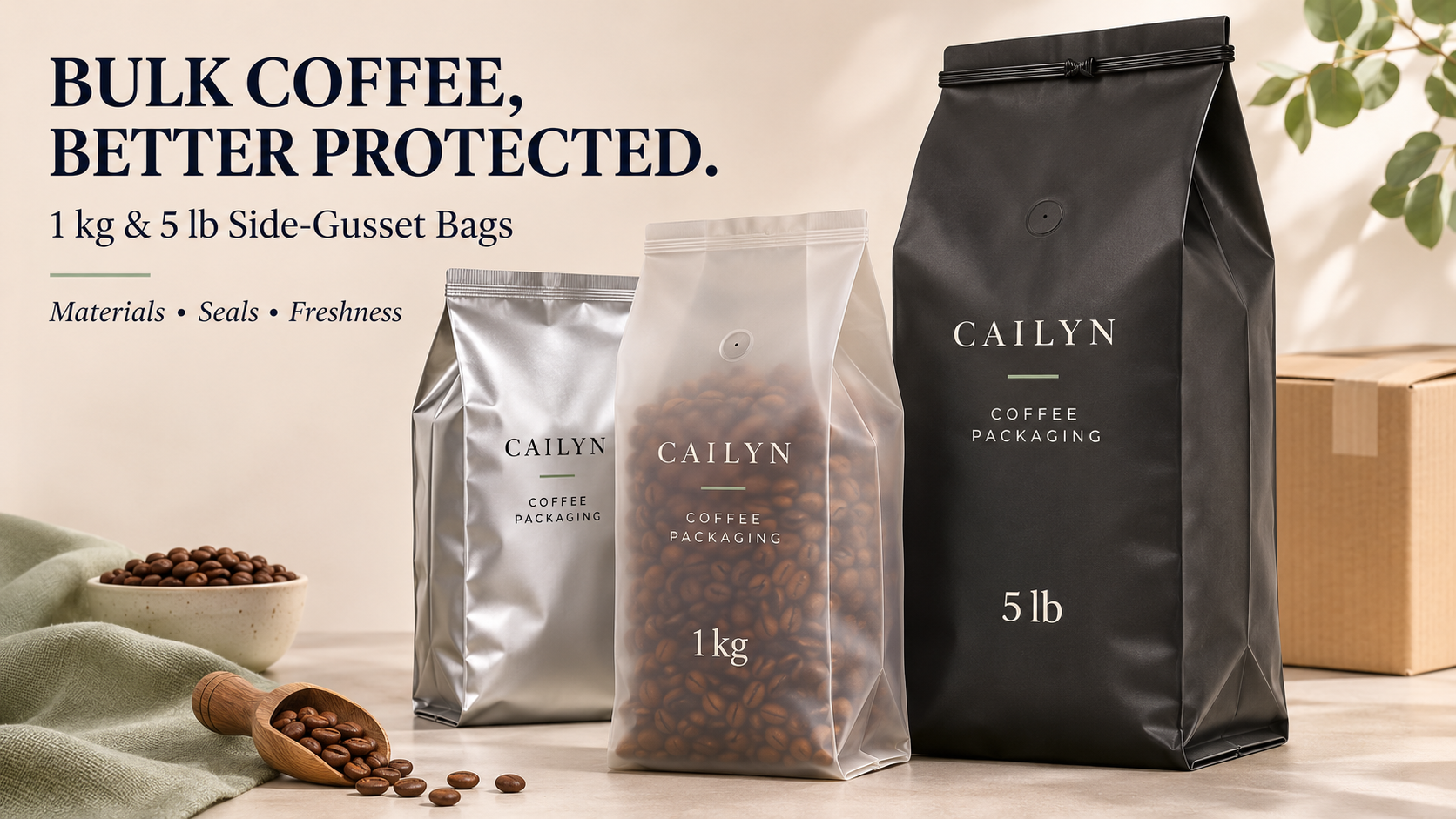
Moving from small retail packs to wholesale coffee supply brings new packaging challenges. A larger bag needs to protect freshness, carry more weight, work with the filling process and withstand handling throughout distribution.
For roasters choosing 1kg and 5lb side-gusset coffee bags, reliable performance depends on more than film thickness. Bag dimensions, material structure, seals, degassing valves and shipping cartons all contribute to the result.
At Cailyn, we help customers balance these requirements with their artwork, preferred finish and target shelf life.
Why Choose Side-Gusset Bags for Bulk Coffee?
Side-gusset bags have expandable folds on both sides, creating room for coffee beans while allowing the empty bags to remain compact before filling. They are widely used for wholesale coffee, café supply and foodservice packaging.
Their practical advantages include:
- Expandable capacity: Side folds provide additional volume without relying only on a wider front panel.
- Adaptable dimensions: Bag width, height and gusset depth can be tailored to the filling weight and carton arrangement.
- Branding space: Front, back and side panels provide space for artwork, roast details and product information.
- Efficient case packing: Properly sized bags can help roasters organize wholesale orders within their shipping cartons.
Standard side-gusset, quad-seal and flat-bottom bags have different constructions. Their standing stability and packing behavior should be assessed using filled samples rather than assumed from the bag’s appearance.
1kg and 5lb Coffee Bags Need Separate Specifications
A 5lb coffee bag holds approximately 2.27kg—more than twice the weight of a 1kg bag. It should therefore be evaluated as a separate packaging specification.
The right dimensions also depend on the coffee itself. Bean size, roast level and bulk density affect the space required for a given weight.
Before confirming a bag size, we recommend checking:
- Actual coffee volume at the intended net weight.
- Headspace for filling and final heat sealing.
- Clearance around the zipper or other closure.
- Compatibility with the filling equipment.
- The number and arrangement of bags in each carton.
Trial filling helps confirm that a bag is practical to use before production begins.
Material Selection: Balancing Strength, Visibility and Shelf Life
At Cailyn, material selection goes beyond bag strength. We also consider the customer’s artwork, preferred finish, intended storage conditions and target shelf life.
For bulk coffee, the complete laminate needs to balance oxygen and moisture protection with toughness, puncture resistance and reliable heat sealing. Increasing thickness alone does not necessarily deliver the best overall performance.
Translucent Matte Materials for Product Visibility
Translucent matte packaging is a popular choice among our customers. It allows consumers to see the coffee beans while creating a soft, understated appearance.
However, compared with aluminum foil laminates, these structures may provide lower oxygen protection, depending on their composition, and less protection from light. The visual effect should therefore be considered alongside the intended storage period and distribution conditions.
Transparent EVOH Structures for Higher Oxygen Protection
For customers who want visible coffee beans together with stronger oxygen protection, we can recommend transparent high-barrier structures incorporating EVOH.
This approach helps balance product visibility with functional barrier performance. The complete structure—including the layers that protect the EVOH—must be selected for the intended application and storage environment.
Transparent high-barrier packaging does not provide the same light protection as an opaque foil structure. Final selection should reflect how and where the coffee will be stored.
Foil-Based Structures for Opaque Barrier Packaging
For customers who do not need a transparent appearance, aluminum foil laminates are another option for protecting coffee from oxygen, moisture and light.
The final choice should consider the target shelf life, desired appearance, handling requirements and budget. Actual shelf life also depends on the coffee, residual oxygen after packing, seal quality, valve performance and storage conditions.
Seal Design and Drop Resistance
A bag’s ability to withstand handling depends on the complete package, not the bag format alone.
For larger coffee packs, areas requiring attention include the bottom seal, back seal and locations where folded layers meet. Material selection, seal geometry and sealing conditions all affect performance.
At Cailyn, we consider these factors together when developing a bulk coffee bag. The customer’s final top seal is equally important: even a well-made bag can perform poorly if the filling-line seal is incomplete or contaminated with coffee particles.
How to Evaluate Filled-Bag Performance
Before approving a new specification, we recommend a practical validation process:
- Fill sample bags with the actual coffee and target net weight.
- Complete the final heat seal using the intended production conditions.
- Agree on appropriate drop heights, orientations and repetitions for the application.
- Inspect for seal opening, film damage, bean leakage and damage around the valve.
- Evaluate the bags in the intended shipping cartons.
Testing individual bags and packed cartons helps identify different handling risks. Any drop-resistance claim should be tied to the tested specification and conditions.
Degassing Valves for Freshly Roasted Coffee
Freshly roasted coffee continues to release carbon dioxide after roasting. For coffee packed while it is still degassing, a suitable one-way valve allows gas to escape while limiting oxygen entry.
Valve selection and placement should be considered alongside the bag dimensions, artwork and filling level. Installation quality also matters: the valve attachment needs to remain secure without interfering with seals, folds or closures.
A valve supports the packaging system, but it cannot compensate for unsuitable barrier materials or poor sealing.
Closure Options Matched to Your Filling Process
The best closure depends on how the bag will be filled, opened and used.
Side-Positioned Zippers for a Wider Filling Opening
Where compatible with the selected bag construction, a side-positioned zipper can leave a wider opening for filling. This can make it easier to load whole beans efficiently while providing a convenient reclosure feature after opening.
We recommend checking the opening size and zipper position against the customer’s filling equipment or manual packing process before confirming the design.
Tin Ties for a Traditional Coffee-Packaging Style
A tin tie provides a distinctive folded-top appearance that suits many coffee brands. After opening, customers can fold the bag down and secure it with the tie.
Tin ties are reclosure features rather than airtight seals. The initial heat seal provides the sealed closure before the bag is opened.
By matching the closure to the filling process and brand style, roasters can create packaging that is practical to pack and convenient to use.
Custom Printing Across Retail and Wholesale Sizes
Roasters often offer several pack sizes, from smaller retail bags to 1kg and 5lb wholesale formats. A consistent visual identity can connect the range while allowing each size to use an appropriate structure and closure.
Cailyn offers custom printing options for different order requirements:
Digital printing for shorter runs, multiple designs and product launches.
Rotogravure printing for larger production runs, with spot-color matching based on approved references.
Artwork should be reviewed together with the material finish. Transparent areas, matte surfaces, metallic backgrounds and white-ink coverage can all affect the final appearance.
Shipping Protection Goes Beyond the Bag
Bulk coffee bags travel through filling, case packing, palletizing, freight and warehouse handling. The outer packaging should support that journey.
Carton dimensions, board strength, bag arrangement and carton weight all influence shipping protection. Excess space can allow bags to move, while an overly tight arrangement can create unwanted pressure.
For wholesale orders, we recommend reviewing the filled bag and shipping carton together rather than selecting them independently.
Custom 1kg and 5lb Coffee Bags from Cailyn
Cailyn helps coffee brands develop custom packaging around their product, filling process and design goals.
Whether you prefer a translucent matte finish, a transparent EVOH barrier structure or an opaque foil laminate, our team can help assess suitable materials, dimensions, valves, closures and printing options.
To start your project, share your:
- Target fill weight and coffee type.
- Preferred bag style and finish.
- Expected shelf life and storage conditions.
- Filling method and closure preference.
- Order quantity, number of designs and delivery destination.
Contact Cailyn to discuss custom 1kg and 5lb coffee bags and arrange samples for evaluation.