
 EN
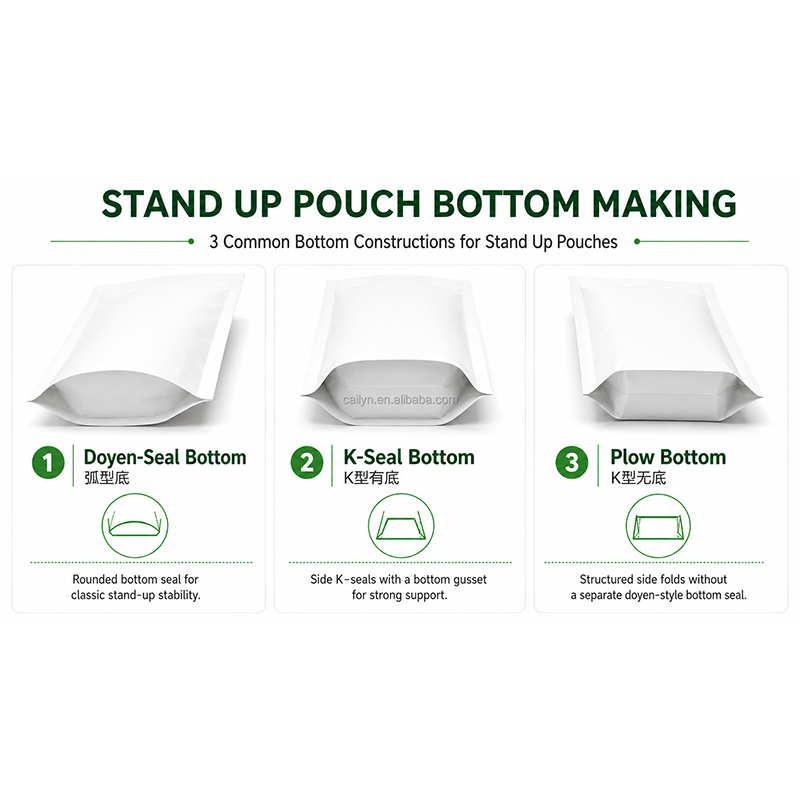
When choosing a stand-up pouch, buyers often focus first on material, size, zipper and print design. The bottom construction is equally important. It affects how the pouch opens after filling, how it presents on shelf, and how much of the internal space can be used.
Three common constructions are the Doyen-seal bottom, the K-seal bottom and the plough-bottom format. The most useful way to compare them is not simply by appearance, but by one practical question: does the pouch have a separately sealed bottom, or can its bottom area open freely after filling?
In this guide, “plough bottom” refers to the K-shaped, no-bottom-seal construction. Terminology can vary between suppliers, so a pouch drawing or physical sample should always be used to confirm the required construction before production.
The Main Structural Difference: Formed Bottom vs. No Bottom Seal
Doyen-seal and K-seal pouches both have a formed bottom. The bottom gusset is controlled by a sealed structure that gives the pouch an established support area when it is filled.
A plough-bottom pouch does not use a separate Doyen-style bottom seal. Its lower section can open more freely after filling. This creates a useful capacity advantage in the same nominal pouch size, but provides less built-in support for upright presentation.
| Bottom construction | Core structure | Capacity within the same pouch size | Shelf support | Main visual character |
|---|---|---|---|---|
| Doyen seal | Formed bottom with a curved bottom seal | Broadly comparable with K-seal when dimensions and gusset depth are the same | Good general stand-up support | Rounded, familiar stand-up pouch profile |
| K-seal | Formed bottom with K-shaped side seals | Broadly comparable with Doyen seal when dimensions and gusset depth are the same | Usually slightly more defined support than a rounded Doyen base | Neater, more structured lower profile |
| Plough bottom / K-shaped no-bottom-seal | Bottom area opens without a separate bottom seal | Greater usable expansion in the same external size | Less built-in support, especially in small pouch formats | Flexible, capacity-led pouch shape |
The comparison above assumes equivalent pouch width, height, side seals and gusset dimensions. Actual fill capacity still depends on the product’s bulk density, particle size, fill level and the way it settles inside the pack.
Doyen-Seal Bottom: The Classic Stand-Up Pouch
A Doyen bottom uses a curved seal across the lower gusset. Once filled, the pouch opens into a familiar rounded base that supports upright display.
This construction is widely used because it creates a balanced combination of flexible packaging efficiency and shelf presentation. It is suitable for many everyday pouch applications, including tea, coffee, powdered products, confectionery and light snacks.
The key benefit is not maximum capacity. It is dependable stand-up presentation in a simple, established format. For compact retail pouches, the formed bottom helps the pack remain easier to arrange and display than a comparable no-bottom-seal pouch.
K-Seal Bottom: A More Defined Formed Base
A K-seal pouch also has a formed bottom, but the lower side seals create a more defined K-shaped structure. Compared with the softer curved profile of a Doyen pouch, it can give the lower section a straighter, more structured appearance.
For the same pouch dimensions and gusset depth, a K-seal pouch should not be promoted as having more capacity than a Doyen pouch. Both are formed-bottom constructions, and their capacity is broadly comparable. The difference is primarily in bottom shape, visual outline and support behaviour.
In practical shelf use, a K-seal base can offer slightly stronger support than a rounded Doyen base. This can be particularly useful for smaller retail formats, where a clean standing profile helps the pouch present more consistently. The final result still depends on material stiffness, fill level and pouch proportions.
Plough Bottom: More Expansion, Less Built-In Support
The plough-bottom format shown here is a K-shaped pouch without a separately sealed bottom. Because the bottom is not constrained by a Doyen-style bottom seal, it can expand more freely after filling.
That is its main advantage: within the same external pouch size, the structure can offer greater usable capacity. It is therefore worth considering when product volume is the priority.
The trade-off is presentation. Without the same formed supporting base, a plough-bottom pouch has less inherent stand-up stability than a Doyen or K-seal pouch. The difference is more noticeable in small pouches, low-fill packs or products that do not settle evenly. A larger format, a suitable fill weight and a stiffer material can improve its appearance, but they do not turn it into the same type of formed-bottom pouch.
Capacity: Compare Internal Expansion, Not Just Outside Dimensions
Two pouches can have the same printed width and height but hold different amounts. To compare capacity fairly, the following points must be considered together:
Pouch width, height and bottom-gusset depth
Side-seal and bottom-seal allowance
Whether the bottom is separately sealed or free to expand
Product density, particle size and settling behaviour
Required headspace below the zipper or top seal
Features such as zippers, valves, spouts or hang holes
This is why a product specification should state the target net weight or fill volume, not only the pouch dimensions. A physical filling trial remains the most reliable way to confirm the final pack size.
Production and Cost: Avoid Assumptions Based on Appearance Alone
Doyen and K-seal bottoms should not be ranked as universally cheaper or more expensive from appearance alone. Material structure, pouch size, order quantity, printing method, finishing requirements and production route all affect the quotation.
For Cailyn’s K-shaped no-bottom-seal construction, dedicated forming tooling may be required. This should be reviewed at the start of the project rather than after artwork approval. It is one reason why a plough-bottom pouch should be quoted from confirmed dimensions and a confirmed pouch drawing.
Bottom construction also does not determine filling speed by itself. Filling performance is influenced more directly by the filling machine, pouch-opening method, product flow, powder dust, static control, fill weight and top-seal cleanliness. Any new pouch structure should be validated with the intended product and filling process.
Which Bottom Construction Should You Consider?
| If your priority is… | A practical starting point |
|---|---|
| A familiar stand-up pouch with dependable retail presentation | Doyen-seal bottom |
| A slightly more defined base and stronger compact-pouch presentation | K-seal bottom |
| Greater usable capacity within the same nominal pouch size | Plough bottom / K-shaped no-bottom-seal pouch |
| Small retail pouches that need to stand neatly on shelf | Doyen or K-seal bottom, with K-seal worth considering for added support |
| A new product with uncertain fill behaviour | Produce samples and complete a filling and shelf-display trial before volume production |
There is no single best bottom construction. A snack pouch that needs strong retail display may benefit from a formed bottom, while a capacity-led pouch may benefit from the freer expansion of a plough bottom. The correct decision should reflect the product, target fill weight, retail environment and how the pouch will be filled and transported.
Develop the Pouch Structure Before Finalising Artwork
At Cailyn, we help brands review pouch size, bottom construction, material structure, closure features and print layout as one packaging project. Before moving to volume production, we recommend confirming the pouch construction with a drawing or sample, then checking fill volume, standing performance and sealing results with the actual product.
This approach helps prevent a common problem in flexible packaging: choosing a pouch by appearance first, then discovering after filling that the capacity or shelf presentation does not meet expectations. A carefully selected bottom construction gives the pouch a better chance to fill, stand and sell as intended.
Table of Contents
- The Main Structural Difference: Formed Bottom vs. No Bottom Seal
- Doyen-Seal Bottom: The Classic Stand-Up Pouch
- K-Seal Bottom: A More Defined Formed Base
- Plough Bottom: More Expansion, Less Built-In Support
- Capacity: Compare Internal Expansion, Not Just Outside Dimensions
- Production and Cost: Avoid Assumptions Based on Appearance Alone
- Which Bottom Construction Should You Consider?
- Develop the Pouch Structure Before Finalising Artwork