
 EN
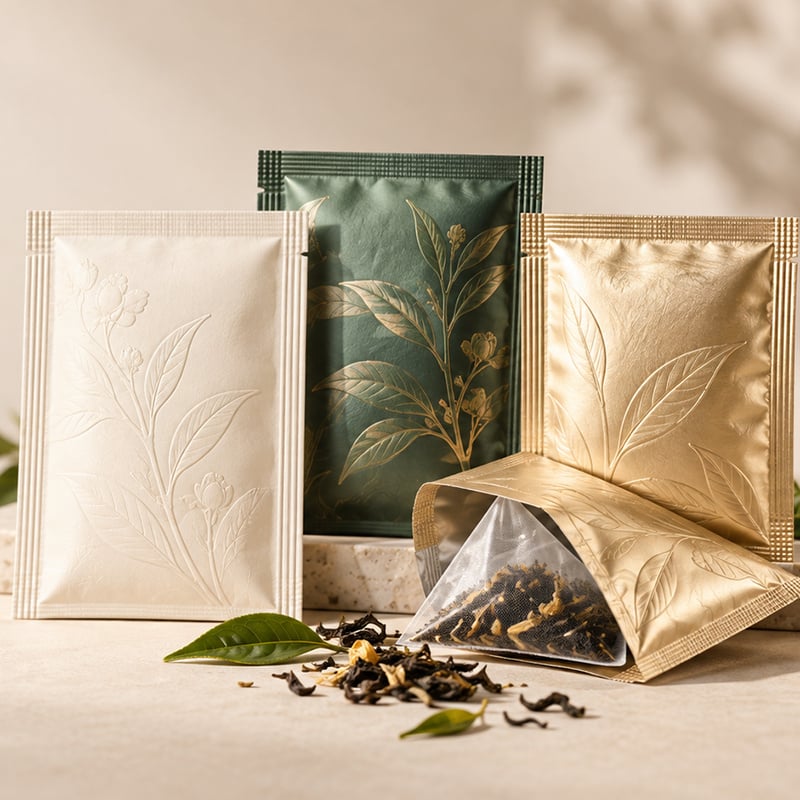
Individual tea bag overwraps are small, but they do important work. Before a customer opens the tea bag, the overwrap helps protect it from humidity, light, oxygen and odours during storage, transport and display. It also creates the first tactile and visual contact with the brand.
For tea brands, the question is not simply whether an envelope should be foil-lined or paper-based. The right choice depends on the tea itself, the intended shelf life, the distribution route, the filling process and the brand’s visual direction. A well-designed overwrap must protect the tea, run reliably in production and fit naturally with the filter bag and retail carton.
What Is an Individual Tea Bag Overwrap?
An individual overwrap is the sealed outer envelope around one tea bag. It is separate from the filter material that holds the tea. Its purpose is to maintain the condition of each portion until brewing, while providing a clean, convenient single-serve format for retail, hospitality, travel and sampling.
The envelope structure needs to deliver more than a good appearance. It should provide an appropriate barrier, consistent heat seals, controlled tear opening and a size that fits the tea bag, string and tag without unnecessary empty space. The carton then groups the finished envelopes into a retail-ready pack.
Three Practical Material Directions
There is no universally “best” overwrap material. These three directions are commonly considered at the beginning of a project.
| Material direction | Typical strengths | Points to assess | Suitable applications |
|---|---|---|---|
| Aluminium-foil laminate | Strong protection from light, moisture and oxygen; premium opaque appearance | Higher material complexity; recycling claims require assessment of the complete structure and local collection route | Aroma-sensitive teas, long distribution routes, humid climates, premium gift lines |
| Metallised-film laminate | A balanced level of barrier performance, cost and shelf appearance; lighter and more flexible than foil structures | Less absolute light barrier than aluminium foil; structure should be selected for the required storage conditions | Everyday retail tea, standard export programmes, high-volume individual sachets |
| Paper-look or paper-based barrier structure | Natural, tactile brand presentation; can support a paper-forward visual identity | Paper alone is not a sufficient moisture or oxygen barrier. Coatings, seal layers and end-market recovery options must be evaluated as a complete system | Fast-turnover lines, organic-style brands, hospitality packs and projects where a natural presentation is central |
Material names alone do not determine performance. The full laminate, its sealant layer, ink system, adhesive, pouch size and sealing parameters all affect the finished envelope.
Start with the Tea, Not the Artwork
Tea sensitivity varies by style and formulation. Delicate green teas, jasmine teas and other floral or aroma-led blends can benefit from stronger protection against light, humidity and external odours. Teas with a roasted or more robust profile may allow more flexibility, but they still need packaging matched to their storage period and route to market.
| Tea or product type | Main packaging concern | Overwrap direction to explore |
|---|---|---|
| Green tea, jasmine tea and floral blends | Preserving fresh aroma and limiting exposure to light and humidity | Foil laminate or a high-barrier metallised structure |
| Black tea and roasted tea blends | Reliable everyday protection and efficient production | Metallised-film laminate or another validated barrier structure |
| Herbal blends | Aroma protection and protection from humidity; ingredient particle size may affect filling and sealing | Metallised or foil laminate, selected after product review |
| Premium sampler or gift collection | Protection plus elevated tactile presentation | Foil laminate, or a paper-look construction with an appropriate barrier layer |
| Hospitality or fast-turnover service packs | Easy opening, clean handling and controlled cost | Paper-look or metallised structure, based on the real storage and distribution conditions |
The required shelf life should be established with the tea producer and validated through the brand’s own product and shelf-life programme. Packaging can support freshness, but it cannot replace correct tea processing, storage or filling controls.
Barrier Protection Is Only as Good as the Seal
An excellent film structure can still fail if the seal is poorly designed or inconsistently produced. Tea bag overwraps should therefore be reviewed as a complete package:
Seal integrity: The heat-seal layer and process settings need to create secure, repeatable seals without damaging the material.
Easy opening: Tear notches, laser scoring or other opening features should suit the structure and user experience.
Envelope dimensions: The pouch should fit the tea bag, string and tag comfortably, without crushing the filter or creating excess loose space.
Odour management: Materials and inks should be appropriate for food-packaging use, while production and storage should avoid exposure to strong external odours.
Production compatibility: The selected material must work with the brand’s filling method, whether tea is packed in China or envelopes are supplied for filling in the destination market.
These details affect both consumer experience and production efficiency. They should be confirmed before final artwork and volume production are approved.
The Overwrap, Filter and Carton Should Be Developed Together
Many tea buyers source filter bags, individual envelopes and cartons from separate suppliers. That approach can create avoidable coordination work: dimensions may not match, colours can vary across paper and film, and shipments of different components may arrive on different schedules.
Cailyn can coordinate the key packaging components as one programme: tea filters, individual overwrap envelopes, labels and retail cartons. Our team reviews the fit between the filter format, envelope dimensions, artwork application and outer-box count before production. Where a specialist production step is involved, Cailyn coordinates the project and retains responsibility for final inspection.
| Packaging component | What should be coordinated | Benefit to the brand |
|---|---|---|
| Tea filter | Material, shape, fill-weight range, string and tag | A consistent brewing and handling experience |
| Individual overwrap | Barrier level, seal area, opening feature and print layout | Better protection and a cleaner single-serve presentation |
| Retail carton | Envelope count, internal dimensions, folding structure and shelf communication | Secure fit, clear retail information and fewer packing issues |
| Transport carton | Pack configuration and stacking strength | More efficient storage and shipment planning |
For brands exporting empty packaging for local filling, foldable cartons can reduce shipping volume. For tea packed at origin, the priority may instead be carton strength, accurate fit and stable presentation after filling. The best box structure should follow the supply-chain plan, not decoration alone.
Printing and Design Considerations
The outer envelope is a small format, so its design needs disciplined information hierarchy. The tea name, blend type, flavour cues and opening direction should remain clear at a glance. Fine details and light text require particular care on textured paper-look materials or metallic surfaces.
For sampling, market testing or limited artwork versions, digital printing may be a practical route where the chosen material and finish are compatible. For sustained higher-volume programmes, the appropriate conventional printing process can provide stable repeat production against approved colour targets. The recommended method depends on the structure, finish, quantity and artwork—not quantity alone.
Paper-look, matte, gloss and metallic visual effects can all support different brand positions. A natural appearance should not, however, lead to a lower protection level than the tea requires. Material performance should be set first; surface style should then be built around it.
Sustainability: Make Claims Only After Reviewing the Full Structure
Single-serve tea packaging needs to balance material use with the need to protect the tea. A paper-facing envelope may look more natural, but its environmental profile cannot be judged from the outer layer alone. Barrier coatings, sealant layers, inks and adhesives all matter, as do the collection and recycling systems available in the destination market.
For this reason, sustainability claims should be made only after the complete envelope structure and intended market have been assessed. In many cases, the most responsible decision is to use the minimum structure that still provides the required product protection, thereby helping to avoid unnecessary product loss and premature replacement.
Choosing the Right Tea Bag Overwrap Partner
When comparing overwrap suppliers, ask practical questions: What tea is being packed? How long will it be stored? Will it travel through hot or humid conditions? Which tea filter and carton will be used? Where will final filling take place? And which sustainability claim, if any, can be supported in the target market?
Cailyn supports tea brands from packaging concept through material selection, printing coordination, production and final inspection. By bringing filters, individual envelopes and cartons into one coordinated packaging programme, we help reduce unnecessary supplier handovers and make the finished tea pack more consistent from the production line to the shelf.
The right overwrap is not simply the most expensive material or the most natural-looking one. It is the structure that gives your tea the protection, presentation and production reliability required for its actual route to market.
Table of Contents
- What Is an Individual Tea Bag Overwrap?
- Three Practical Material Directions
- Start with the Tea, Not the Artwork
- Barrier Protection Is Only as Good as the Seal
- The Overwrap, Filter and Carton Should Be Developed Together
- Printing and Design Considerations
- Sustainability: Make Claims Only After Reviewing the Full Structure
- Choosing the Right Tea Bag Overwrap Partner