
 EN
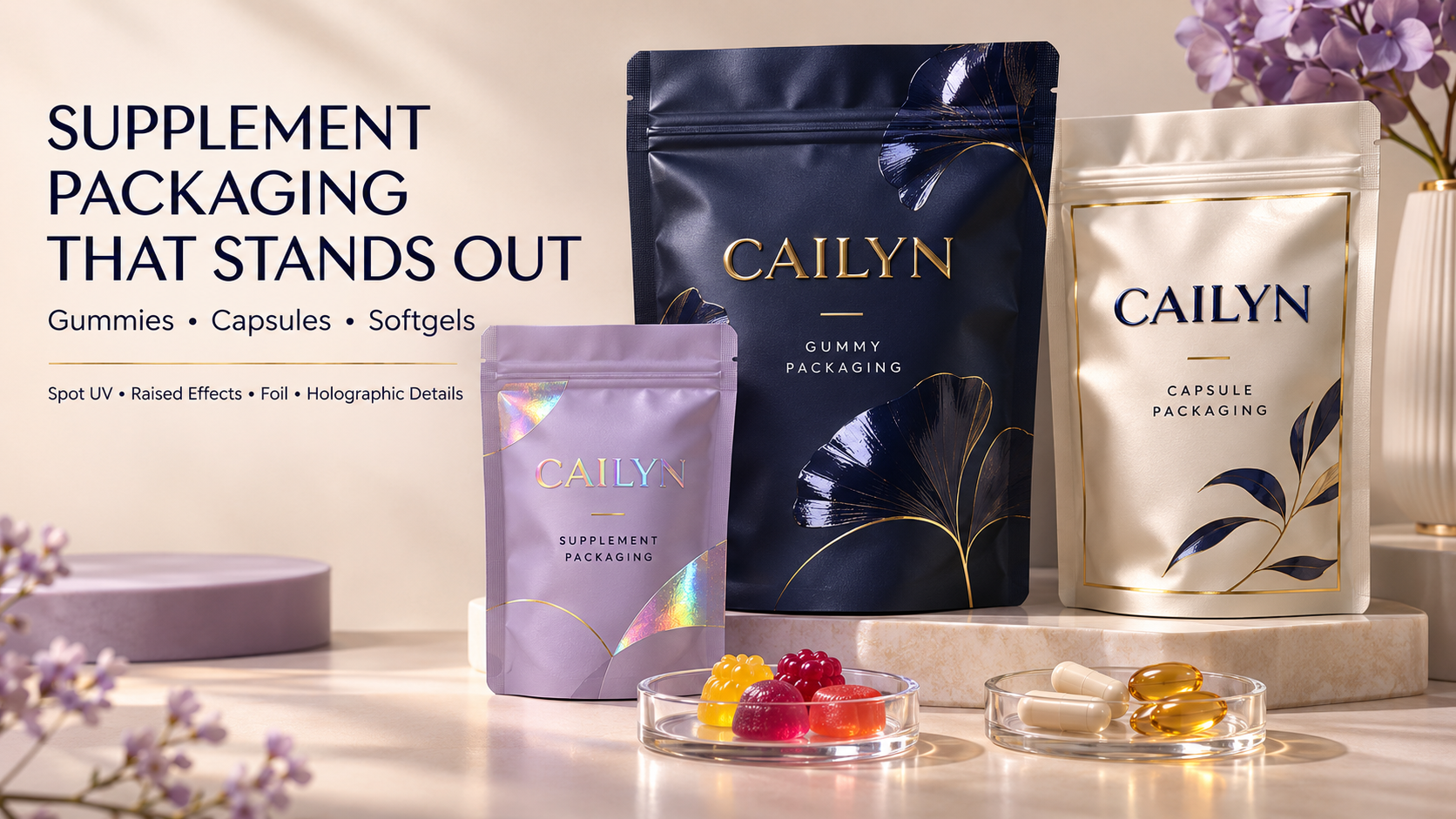
Gummy and capsule packaging needs to protect the product while giving customers a clear reason to notice the brand.
Material selection helps control exposure to moisture, oxygen and light. Printing and decorative finishes create visual contrast, highlight the logo and communicate product identity.
At Cailyn, we develop these elements together. From metallized barrier structures to spot UV, raised effects and selective holographic details, the aim is packaging that balances protection, production requirements and shelf appeal.
Start with the Product and Its Storage Requirements
A gummy blend, a hard-shell capsule and an oil-filled softgel can present different packaging challenges.
Before recommending materials, Cailyn considers:
Product type and formulation.
Sensitivity to moisture, oxygen and light.
Target shelf life.
Storage and distribution conditions.
Filling and sealing process.
Expected use after opening.
Required package size and appearance.
The same laminate should not automatically be used for every supplement simply because the products share a similar packaging format.
Gummies, Hard Capsules and Softgels Have Different Needs
|
Product Type |
Packaging Priorities |
Practical Considerations |
|
Gummies |
Control moisture exchange, protect appearance and support formula stability |
Texture, surface coating, stickiness, filling temperature and storage conditions |
|
Hard-shell capsules |
Maintain appropriate moisture conditions and protect the contents |
Shell material, risk of brittleness or softening, and formulation sensitivity |
|
Oil-filled softgels |
Protect both the shell and the filling |
Oxygen and light sensitivity, shell compatibility and storage temperature |
These are starting points for packaging development, not fixed specifications.
Gummies: Control Moisture Exchange
Gummies can change texture when they gain or lose moisture.
Depending on the formulation and environment, moisture uptake may contribute to stickiness, while moisture loss may make the product firmer than intended.
The aim is to maintain suitable product conditions—not simply to remove as much moisture as possible.
Packaging cannot compensate for an unsuitable formulation or uncontrolled storage temperatures. Evaluation should use the actual gummy product.
Hard Capsules: Consider the Shell and the Filling
Hard capsules may use different shell materials, and both the shell and the contents need consideration.
Excessive moisture and excessive drying can create different problems. Desiccants should therefore not be added automatically; their suitability and quantity should be established by the product manufacturer.
The film structure should support the required moisture conditions while providing any necessary oxygen or light protection.
Softgels: Evaluate Both Components
For softgels, the shell and its filling may have different sensitivities.
An oil-based filling may require oxygen or light protection, while the shell also needs appropriate storage conditions.
Product-packaging compatibility should be assessed with the actual formulation rather than inferred from water-based or dry-product applications.
Light Protection: More Than a UV Claim
Some supplement ingredients are sensitive to light, but the relevant wavelengths and degree of sensitivity depend on the formulation.
Suitable metallized films can reduce light transmission, including UV exposure. However, performance varies between grades and constructions.
If a brand requires a specific UV-blocking claim, it should be supported by appropriate light-transmission data covering the relevant wavelength range.
Opaque printing, metallized films and aluminum foil structures provide different types and levels of protection. They should not be treated as interchangeable.
What About Transparent Windows?
A window allows customers to see the product but creates an area with different light-protection characteristics.
A clear film may provide oxygen protection while still transmitting light. White ink or a tinted appearance should not automatically be treated as a validated UV barrier.
Window size, display lighting and the use of an outer carton should be considered together.
How Metallized Barrier Laminates Work
A common candidate structure is PET/VMPET/PE:
PET outer layer: Supports printing and contributes mechanical properties.
VMPET layer: Metallized PET that contributes barrier and light-protection properties according to its grade.
PE inner layer: Provides a food-contact sealing surface when appropriately specified.
The exact materials and thicknesses should be selected around the product and production process.
A metallic-looking pouch does not automatically provide a particular level of protection. Metallization quality, laminate construction, seals and handling all matter.
Not every metallized laminate needs an additional EVOH layer. Each layer should serve a defined purpose in the specification.
Compare Material Options
|
Material Option |
Potential Advantages |
What to Evaluate |
|
Metallized laminates |
A balance of barrier performance, light protection and appearance |
Film grade, metallization quality, flex durability and seals |
|
Aluminum foil laminates |
Strong light protection and high barrier potential |
Handling durability, pinholes, flexing and finished-pack integrity |
|
Transparent high-barrier structures |
Product visibility with suitable oxygen protection |
Moisture performance, humidity conditions and separate light protection |
|
Suitable mono-material structures |
An option for projects with recycling objectives |
Required barrier, sealing, mechanical performance and local collection systems |
These options are starting points for development, not guarantees of equivalent performance.
EVOH-based structures can be considered where appropriate for oxygen protection, but the complete laminate must also address moisture and light requirements.
Specify Barrier Performance with Data
A material name or total thickness is not a complete specification.
Useful information may include:
|
Property |
Purpose |
|
Oxygen transmission rate, or OTR |
Assess oxygen passage through the material |
|
Water vapor transmission rate, or WVTR |
Assess moisture passage through the material |
|
Light-transmission data |
Evaluate protection across relevant wavelengths |
|
Seal strength and integrity |
Assess the reliability of the finished closure |
|
Lamination bond strength |
Evaluate layer adhesion |
|
Handling durability |
Check resistance to damage during packing and distribution |
Barrier figures should be compared under matching test conditions. Temperature, humidity and test methods affect how results are interpreted.
The finished pouch should also be evaluated, since seals, folds and handling can affect performance.
Sealing Matters as Much as the Film
A high-barrier laminate cannot compensate for an incomplete seal.
For gummy products, sugar, oil or product residue may contaminate the sealing area. Capsules or fragments can also interfere if they enter the seal zone.
Development should consider:
Filling accuracy and product clearance.
Clean sealing surfaces.
Suitable seal width.
Sealing temperature, pressure and contact time.
Seal performance after handling.
Trial packs should be checked for incomplete seals, channels and leakage using agreed methods.
Choose the Format Around Consumer Use
Resealable Stand-Up Pouches
Stand-up pouches can offer convenient retail presentation and reclosure for multi-serving products.
However, a zipper does not restore the original sealed environment after opening. Pack size and expected consumption time should therefore be considered alongside the barrier structure.
Flat Pouches and Small Portion Packs
Smaller sealed packs can reduce repeated exposure of the remaining product.
They may suit travel packs, trial quantities or portioned products, depending on the brand’s requirements.
Rollstock Film
Rollstock can be supplied for compatible automatic form-fill-seal equipment.
Before production, Cailyn confirms unwind direction, film width, repeat length, equipment roll-weight limits and individual layer thicknesses.
A sample-roll trial helps assess forming, filling, sealing and opening on the customer’s equipment.
Match Package Size to the Actual Product
A stated weight or capsule count does not define one universal bag size.
Gummy shape, capsule dimensions and bulk density affect the space required. Different brands may also prefer tall, slim or wider pouch proportions.
At Cailyn, width, height and gusset depth can be customized around the product, artwork and filling process.
Trial filling should confirm capacity and allow sufficient room for the closure and final heat seal. Dimensions can be provided in both millimeters and inches.
Custom Printing and Finishes That Highlight Your Brand
Protective materials are only part of packaging development. Printing and finishing can also help a supplement brand stand out and communicate its product identity.
At Cailyn, we offer decorative effects that can be applied selectively to emphasize a logo, product name or key design element.
Spot UV and Selective Gloss
Spot UV and selective gloss create contrast between highlighted areas and the surrounding surface.
A glossy logo against a matte background, for example, can attract attention without covering the entire pouch in a reflective finish.
These effects can also highlight product names, illustrations or selected visual details, helping guide attention to the most important parts of the design.
Raised Effects for Tactile Emphasis
Raised embellishments add texture and dimension to selected areas of the artwork.
Applied to a logo or brand symbol, they create a detail that customers can see and feel.
The effect should be developed around the packaging substrate and desired presentation. The appropriate technique and achievable result can be confirmed through samples.
Foil Stamping
Gold, silver and other available foil finishes can emphasize logos, product names or decorative elements.
A selective application creates a focal point while keeping the overall design clean and readable.
Foil color, placement and durability should be reviewed with the chosen material and finishing process.
Selective Holographic Effects
For designs using a suitable holographic substrate, selected areas can remain visible through the printed artwork to reveal the underlying rainbow effect.
This allows a logo, pattern or accent to change appearance as the package moves under light, while other areas remain opaque or matte.
The decorative holographic effect should be assessed separately from the laminate’s protective barrier performance.
Combine Effects with a Clear Purpose
A design can combine a matte background with a selectively glossy logo, raised details, foil accents or exposed holographic patterns.
The most effective combination depends on the brand style and the message the packaging needs to communicate. Selective finishing can direct attention to the logo or product identity without making every part of the design compete for attention.
Availability should be confirmed for the selected substrate, order quantity and production route.
Coordinate Artwork, Materials and Production
Digital printing can suit shorter runs, multiple designs and new product launches. Rotogravure printing can suit larger production runs, with spot-color matching based on approved references.
Not every decorative effect is available through every printing route. Printing and finishing should therefore be planned together.
At Cailyn, we review:
Placement of logos and highlighted design elements.
White-ink coverage and metallic backgrounds.
Transparent or holographic areas.
Seal areas, folds and gussets.
Zipper position and opening clearance.
Variable coding space.
Machine-contact surfaces for rollstock.
Surface durability during packing and transport.
Samples help customers assess appearance, feel and handling performance before approval.
Validate Shelf Life with the Actual Product
Packaging can help limit environmental exposure, but it does not independently establish supplement stability or potency.
Evaluation should use the actual product in the proposed package under relevant conditions.
Depending on the product, the brand may assess:
Appearance, color and odor.
Gummy texture and sticking.
Capsule or softgel condition.
Moisture-related changes.
Relevant ingredient stability.
Seal and package integrity.
Performance after opening.
Accelerated studies may support development, but their interpretation should be established by the product manufacturer. They should not automatically be treated as a substitute for all real-time evaluation.
Sustainability: Assess the Complete Package
Metallized, foil-based and mixed-material structures should not automatically be described as recyclable.
Recyclability depends on the complete package, accessories, decorative features and destination-market collection systems.
Where alternative structures or finishes are considered, the required shelf life and production performance should be confirmed before making changes.
The aim is appropriate protection, effective presentation and supported environmental claims.
Custom Gummy and Capsule Packaging from Cailyn
Cailyn develops custom pouches and printed rollstock around the formulation, filling process and design requirements of supplement brands.
Whether you are packaging gummies, hard capsules or softgels, our team can help compare suitable barrier structures and develop a distinctive visual finish.
Options include spot UV, selective gloss, raised effects, foil stamping and selective holographic details, with availability confirmed for the chosen specification.
Share your product type, target filling weight or count, shelf-life requirements, storage conditions, preferred format, design ideas and order quantity with Cailyn. Our team can help develop a coordinated packaging specification and arrange samples for evaluation.
Table of Contents
- Start with the Product and Its Storage Requirements
- Gummies, Hard Capsules and Softgels Have Different Needs
- Light Protection: More Than a UV Claim
- How Metallized Barrier Laminates Work
- Compare Material Options
- Specify Barrier Performance with Data
- Sealing Matters as Much as the Film
- Choose the Format Around Consumer Use
- Match Package Size to the Actual Product
- Custom Printing and Finishes That Highlight Your Brand
- Coordinate Artwork, Materials and Production
- Validate Shelf Life with the Actual Product
- Sustainability: Assess the Complete Package
- Custom Gummy and Capsule Packaging from Cailyn